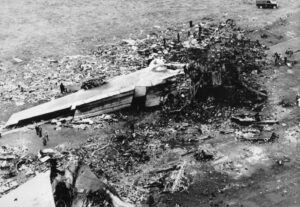
Summary
Japan Airlines Flight 123 represents a systemic structural failure arising from long-term material fatigue progression, maintenance system partitioning, and incomplete continuity in structural repair integrity tracking.
From a system perspective, the event emerged when localized structural degradation accumulated beyond the ability of the aircraft’s global structural integrity model to maintain coherence between assumed and actual load-bearing capacity.
The critical failure was not a single structural defect, but the collapse of structural state continuity across time within the maintenance and inspection system.
Event Overview
System State Context
On August 12, 1985, the aircraft was operating in cruise flight when a rapid decompression event occurred following structural failure of the aft pressure bulkhead.
This bulkhead formed a critical load-bearing boundary between pressurized and unpressurized sections of the fuselage, and its integrity was essential to maintaining global aircraft structural equilibrium.
The system had previously undergone a tail strike event years earlier, after which structural repair processes were executed under existing maintenance protocols.
System Evolution Prior to Failure
Following the structural repair event, the aircraft entered a long-term operational phase where:
Load cycles continued to accumulate across repaired structural regions
Inspection intervals operated under segmented maintenance documentation systems
Structural reinforcement continuity relied on localized repair records rather than unified lifecycle modeling
Within this configuration, structural health existed as a distributed dataset rather than a continuously integrated system state.
System-Level Analysis
- Fragmentation of Structural Integrity Representation
Aircraft structural integrity is maintained through distributed inspection, repair, and certification processes that collectively form a global structural state model.
In this case, structural state representation became partitioned across:
Original manufacturing design assumptions
Post-repair documentation layers
Operational load accumulation history
These datasets were not fully unified into a single continuous structural lifecycle model.
As a result, the system’s representation of structural health diverged from the actual accumulated fatigue state.
- Fatigue Propagation Under Cyclic Loading
The aircraft structure experienced repeated pressurization and depressurization cycles, introducing cyclic stress at critical structural joints.
Over time, this produced progressive fatigue propagation within high-stress regions, particularly around previously repaired structural interfaces.
From a systems perspective, fatigue is not a discrete event but a continuous state evolution process that requires consistent tracking across the full lifecycle of the structure.
- Maintenance System Partitioning and State Discontinuity
Maintenance operations were executed through distributed organizational and procedural layers, each responsible for partial aspects of structural integrity management.
This created a system in which:
Inspection results were localized to specific maintenance cycles
Repair documentation was stored as discrete event records
Long-term structural continuity modeling was not fully integrated across lifecycle phases
This introduced discontinuities in structural state tracking, preventing full reconstruction of cumulative fatigue state.
- Loss of Global Load Path Integrity Awareness
The aircraft structural system depends on continuous load path integrity, where forces are distributed across interconnected structural elements.
As fatigue progressed in a localized region, the system’s global model did not fully reflect the evolving reduction in load-bearing continuity.
This created a divergence between:
Actual structural load distribution capacity
System-maintained structural integrity representation
The gap between these two states increased over time without triggering a full system-level re-evaluation.
- Final State Transition and Structural Collapse
During flight, the compromised structural region reached a critical threshold where accumulated fatigue exceeded residual load capacity.
This resulted in a rapid structural failure event that disrupted pressurization containment and compromised overall aircraft structural stability.
At the system level, this represented a sudden convergence of long-term distributed degradation into a single catastrophic state transition.
Why the System Failed
The failure emerged from the interaction of multiple system-level conditions:
Fragmentation of structural integrity data across maintenance and operational systems
Incomplete lifecycle integration of fatigue accumulation modeling
Reliance on discrete repair records rather than continuous structural state representation
Progressive divergence between modeled and actual structural load-bearing capacity
Absence of unified long-term structural state reconciliation mechanisms
Individually, each condition was within acceptable maintenance and certification frameworks. In combination, they allowed structural state to drift outside the bounds of system awareness.
Key System Lessons
Structural health must be modeled as a continuous lifecycle state, not discrete maintenance events
Repair systems must preserve global load path continuity awareness across time
Distributed maintenance data must be unified into a single structural integrity model
Fatigue is a system-level accumulation process, not a localized defect phenomenon
System safety depends on continuity of state representation across operational and maintenance domains
Conclusion
Japan Airlines Flight 123 demonstrates a systemic breakdown in structural state continuity across time.
From a systems perspective, the critical failure was not a single structural defect, but the inability of the system to maintain an accurate, continuous representation of cumulative structural fatigue within a distributed maintenance architecture.
The event illustrates how complex structural systems fail when long-term degradation processes are not fully integrated into a unified lifecycle state model.