The Event
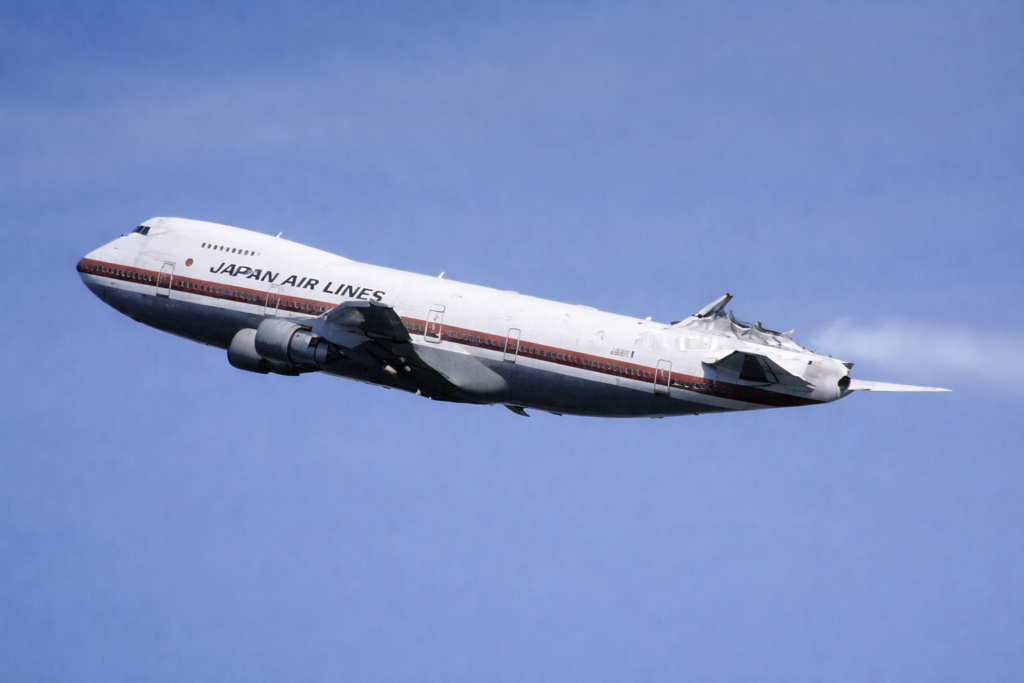
- June 1978: Aircraft JA8119 suffers a tailstrike at Osaka Airport, damaging the aft pressure bulkhead
- Boeing engineers conduct a repair — but install the splice plate in a single row of rivets instead of the required two-row configuration
- The repair provides approximately 70% of the required fatigue strength; it is inspected and approved
- Over the following seven years, 12,319 pressurisation cycles load and unload the improperly spliced joint
- A fatigue crack propagates from the repair, growing cycle by cycle below the detection threshold
- 12 August 1985: Departing Haneda for Osaka, the bulkhead ruptures explosively at 23,900 feet
- The pressure wave destroys the vertical stabiliser; all four hydraulic systems are severed
- The crew attempt to control the aircraft with differential thrust for 32 minutes
- The aircraft enters an uncontrollable phugoid oscillation and strikes Mount Osutaka
- 520 people die; 4 passengers survive — the deadliest single-aircraft accident in history
Japanese Self-Defence Force helicopters located the crash site within hours, but ground rescue teams did not reach it until the following morning. Investigation suggested that some of the 4 survivors could have been rescued earlier had the response been faster.
Systems Engineering Perspective
From a systems engineering perspective, JAL 123 presents two distinct but compounding failures: a maintenance quality failure in the original 1978 repair, and an architectural design vulnerability in the hydraulic system routing that made a bulkhead failure automatically catastrophic. Either failure in isolation would have been serious. Together, they were unsurvivable.
The 1978 repair was the accident. The 1985 crash was the consequence. Seven years and 12,319 flights separated the cause from the effect.
The Improper Repair — Geometry That Guaranteed Failure
The aft pressure bulkhead of a 747 is the critical structural element that separates the pressurised passenger cabin from the unpressurised tail section. In routine operation, it experiences the full pressure differential between cabin and exterior on every single flight. Its fatigue life must be sufficient to sustain these cycles across the aircraft’s designed service life.
The two-row rivet configuration specified for the splice plate repair provides fatigue strength by distributing the load across two rows of fasteners. The single-row configuration actually installed concentrates the load at a single row, creating a stress intensity approximately 1.7 times higher than specified. Under this elevated stress, the fatigue life of the repair was reduced to roughly 70% of the required value — insufficient for the aircraft’s expected service life.
The repair passed inspection because the inspection was a visual and dimensional check of the as-built configuration, not an analysis of the fatigue implications of the configuration that had been built.
A structural repair that provides less fatigue life than required is not a completed repair. It is a component with a shorter remaining life than the aircraft it is installed in.
Hydraulic System Routing — Common Physical Vulnerability
The Boeing 747 has four independent hydraulic systems — a level of redundancy that, under virtually any conceivable failure scenario, should guarantee some residual flight control authority. The systems are designated 1, 2, 3, and 4, and are routed through physically separated paths within the aircraft.
However, all four systems pass through the tail section in proximity to the aft pressure bulkhead. When the bulkhead ruptured, the explosive pressure wave damaged and eventually severed all four hydraulic systems. The independence that the design provided against individual hydraulic failures offered no protection against a single, physically proximate catastrophic event.
This mirrors the DC-10 hydraulic routing vulnerability exposed in United 232. Both aircraft had genuine hydraulic redundancy that was defeated by a single structural event affecting their common physical location.
Four independent hydraulic systems routing through the same physical zone are, for events that affect that zone, one system with no redundancy.
Seven Years of Invisible Damage Accumulation
Over 12,319 pressurisation cycles, the fatigue crack in the repair grew from its initiation point at the single-row splice to a critical length. The growth was sub-threshold for every inspection conducted during that period. The inspection methods — visual checks, dimensional measurements — were not designed to detect sub-surface fatigue crack growth in a repair zone under sustained in-service loads.
The crack was invisible because the inspection programme was designed for the wrong failure mode. It looked for damage caused by operational events — corrosion, impact, visible cracking at accessible surfaces. It was not designed to detect sub-surface fatigue crack growth in a structural repair under sustained cyclic loading.
Human Factors Perspective
The human factors analysis of JAL 123 operates at two levels: the extraordinary, professional performance of the crew during a 32-minute unsurvivable emergency, and the maintenance and quality assurance failures of 1978 that made that emergency inevitable.
Crew Performance Under Total Hydraulic Loss
The CVR of JAL 123 records one of the most sobering documents in aviation history: a crew working systematically, professionally, and with apparent calm through an emergency for which no procedure existed and from which no recovery was possible. Captain Takahama called for checklists that did not apply, then adapted. He requested emergency landing clearance at multiple airports. He and his crew worked together, without panic, until the aircraft struck the mountain.
The quality of their performance — technically correct, procedurally disciplined, coordinated as a crew — made no difference to the outcome because the aircraft’s condition was beyond recovery. The system had failed them 12,319 flights earlier. Their skill and professionalism were not inadequate. They were irrelevant, because the system that should have protected them had already failed.
A crew can perform perfectly and still die because the maintenance system that should have protected them failed seven years and 12,319 flights before they took the cockpit.
The Maintenance Quality Gap
The Boeing repair team of 1978 did not intentionally install an inadequate repair. They followed a process that produced a non-conforming result. The inspection process that followed did not detect the non-conformance because it was not designed to assess the fatigue implications of the as-built configuration against the design requirement.
The gap was in the quality assurance architecture: the absence of a check that compared the actual repair configuration against the design drawing for the safety-critical parameter — rivet row count — and flagged any deviation as non-conforming.
The Families and the System
Japan Airlines later publicly apologised to the families of the 520 victims and acknowledged institutional responsibility for the accident. The accident transformed Japanese aviation safety culture, accelerating the adoption of SMS principles and non-punitive safety reporting frameworks that prioritise learning over blame.
System Interaction Breakdown
1. Non-Conforming Repair Released to Service
The repair was built to a configuration that did not meet the design specification. The quality assurance process did not detect the non-conformance. The aircraft entered service with a structural element whose fatigue life was insufficient for its intended operating life.
Quality assurance for safety-critical structural repairs must verify the actual configuration against the design specification, not merely verify that a repair has been performed.
2. Inspection Blind to the Failure Mode
The inspection programme over the following seven years was conducted correctly to its specified scope. The scope could not detect the failure mode. The match between inspection capability and actual risk was never assessed.
3. Catastrophic Architecture — Bulkhead to Hydraulics
Bulkhead failure → fin destruction → hydraulic line severance → total loss of control. Each step was structurally guaranteed by the aircraft’s physical architecture. No redundant system or alternative pathway existed to interrupt the cascade once the bulkhead ruptured.
When a single structural failure guarantees a cascade to total loss of control through physical architecture, the redundancy of the intervening systems provides no safety benefit.
Significance in Aviation Risk
1. Structural Repair Quality Assurance
Repair documentation, quality assurance, and independent verification standards were fundamentally revised globally following JAL 123. Critical structural repairs must now be verified against the design specification for safety-critical parameters before being released to service.
2. Cycle-Based Fatigue Tracking for Repaired Components
Repaired structural components are now subject to cycle-based life tracking with enhanced inspection requirements, separate from the standard aircraft inspection programme, to ensure that repair-zone fatigue is monitored independently.
3. Physical Separation of Redundant Hydraulic Systems
New aircraft designs were required to provide physical separation of redundant hydraulic and flight control system routing to prevent common-cause loss of all systems from a single localised structural failure.
Related Aviation Risk Lab Content
Pillar Pages
Maintenance and Airworthiness: Maintenance And Airworthiness
Systems Engineering: Systems Engineering
Human Factors: Human Factors
Related Case Studies
Case Study 6: United 232 — Hydraulics, Teamwork and the Impossible Landing: United 232
Case Study 7: Aloha Airlines 243 — The Fuselage That Flew Apart: Aloha 243
Case Study 39: China Airlines 611 — The Repair That Held for Twenty-Two Years: China Airlines 611
Closing Perspective
Japan Airlines 123 is the consequence of a maintenance system that produced an error in 1978 and had no mechanism to detect or correct it before the error became fatal. The repair was wrong the day it was installed. The inspection programme over the following seven years was not designed to find it. The aircraft flew 12,319 more flights on a structure that was guaranteed to fail.
Five hundred and twenty deaths are the price of a maintenance quality assurance system that could not distinguish a conforming repair from a non-conforming one. The structural specification existed. The design drawing existed. The repair deviated from both. And no one in the approval chain had a process that would have caught it.
The legacy of JAL 123 is the comprehensive quality assurance framework for structural repairs that now exists in every major maintenance organisation. Every critical repair is now checked against its design specification for the parameters that govern its structural integrity. That check exists because 520 people died without it.
JAL 123 is the reason that ‘repair completed’ and ‘repair verified as conforming’ are now two separate, mandatory entries in every critical structural maintenance record.