Risk assessment is aviation’s most important proactive safety activity. It is the structured process of identifying hazards, evaluating the probability and severity of their consequences, and determining what controls are required to bring that risk to a tolerable level. Done well, it prevents accidents. Done poorly — or not done at all — it defers accidents until the conditions for their occurrence are met.
The history of aviation accidents is, in large part, the history of risks that were known but not adequately assessed, or assessed but not adequately controlled. The centre wing tank on TWA 800 had produced two previous explosions. The MCAS system on the Boeing 737 MAX was classified at a severity level that did not reflect its actual failure consequences. The cargo door on the DC-10 had produced an incident that fully documented the failure mode. In each case, a risk existed, was identified, and was not adequately addressed. Risk assessment is the system that should prevent this. When it fails, people die.
What Is Risk Assessment in Aviation?
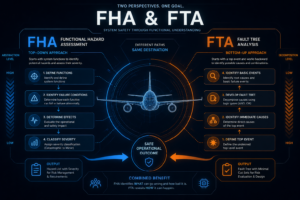
Formal risk assessment in aviation uses structured methodologies — Fault Tree Analysis (FTA), Failure Mode and Effects Analysis (FMEA), Hazard Identification and Risk Assessment (HIRA), and the Bowtie model — to systematically identify what could go wrong, trace the failure paths, and evaluate the adequacy of existing barriers.
Risk is typically expressed as the product of probability (how likely is the hazard to produce this consequence) and severity (how bad is the consequence if it occurs). Aviation uses specific probability and severity criteria: catastrophic consequences (loss of aircraft and/or multiple fatalities) must be ‘extremely improbable’ (less than 10⁻⁹ per flight hour). These criteria exist in ICAO standards and national certification regulations.
Key Topics and Concepts
This page draws together research, case studies, and analysis across the following areas:
Hazard Identification
The first step in risk assessment — finding all the ways the system can fail. Techniques include brainstorming, historical accident analysis, functional analysis, FMEA, and expert elicitation. The quality of the risk assessment depends entirely on the completeness of the hazard identification.
Probability and Severity Matrices
The tools for quantifying risk. In aviation, probability ranges from ‘frequent’ (likely to occur many times) to ‘extremely improbable’ (unlikely to occur in the entire life of the fleet). Severity ranges from ‘negligible’ to ‘catastrophic.’
Risk Tolerability Criteria
The standard against which assessed risk is measured. ICAO and national regulators define the maximum tolerable probability for each severity level. Below the threshold: acceptable. Above it: controls required. Far above it: intolerable regardless of controls.
Bow-Tie Analysis
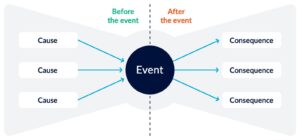
The risk management framework that visualises a hazard event at the centre (‘bow-tie knot’), with threat paths on the left (causes leading to the event) and consequence paths on the right (outcomes), with barriers mapped at each stage. The most useful risk communication tool in aviation safety management.
Conflict Zone Risk Assessment
The specific application of risk assessment to routing decisions over or near conflict zones — particularly relevant following MH17 and the development of ICAO’s Conflict Zone Information Repository.
Acceptable Risk and ALARP
‘As Low As Reasonably Practicable’ — the principle that risk must not just be below the tolerable threshold but should be reduced as far as reasonably achievable. The principle that drives continuous safety improvement beyond mere compliance.
Precursor and Leading Indicator Analysis
The use of near-miss data, safety reports, and operational anomalies to identify and assess risks before they produce accidents. The most valuable — and most underused — risk assessment tool in aviation.
The Systems View
Risk assessment connects systems engineering (identifying what can fail) to safety management (deciding what to do about it). A risk that has been identified, assessed, and controlled is a risk that the system has managed. A risk that has been identified but not acted upon is a managed liability, not managed safety. The gap between identifying and acting is where most preventable accidents live.
Risk assessment connects systems engineering (identifying what can fail) to safety management (deciding what to do about it). A risk that has been identified, assessed, and control…
Featured Case Studies
The following case studies on Aviation Risk Lab directly explore risk assessment in aviation failures, near-misses, and systemic lessons:
TWA 800 — Known Risk, No Action: Twa 800
Lion Air 610 — MCAS Classification Error: Lion Air 610
MH17 — Conflict Zone Risk Assessment Failure: Mh17
Lauda Air 004 — ‘Extremely Improbable’ Was Not: Lauda Air 004
American Airlines 96 — Precursor Not Actioned: Aa 96 1972
Concorde 4590 — Accepted Risk That Wasn’t Acceptable: Concorde 4590
Closing Note
Risk assessment is the discipline that transforms ‘something bad happened’ into ‘something bad was prevented.’ Its value is in the accidents it prevents — events that never appear in the accident record because the hazard was identified, assessed, and controlled before it could produce consequences. The invisible success is the point.