In aviation safety systems, independence is one of those concepts that is always present, always referenced, and almost never as clean in practice as it appears on paper, particularly when you look across regulatory systems such as the Federal Aviation Administration, the European Union Aviation Safety Agency, the Civil Aviation Authority, the Civil Aviation Safety Authority, or even broader national systems that align under the standards of the International Civil Aviation Organization.
Across all of them, the intent is broadly the same: safety is not meant to be self-certified in isolation by the same people who design and develop the system, and instead there is supposed to be a clear separation between those who ensure safety through design and those who assure it through independent review and certification oversight.
On paper, that separation is straightforward, almost elegant in its logic, and it forms one of the key structural assumptions behind certification frameworks worldwide, whether you are dealing with design approval, system safety assessments, or compliance demonstration activities.
In practice however, that separation is not always as stable as it appears in the documentation.
The subtle problem is not intent, it is proximity
Most organisations do not deliberately compromise independence, and in most cases the formal structure of review, approval, and oversight remains intact, but what tends to change over time is proximity, both organisational and technical, between the people who are developing the system and the people who are reviewing it.
As programs mature, design complexity increases, supplier inputs become more critical, and specialist knowledge tends to concentrate in fewer individuals, which means the same people who understand the system most deeply are often the ones most heavily involved in both the development and the clarification of safety artefacts that are later subject to independent review.
This is rarely a deliberate erosion of independence, it is usually a consequence of efficiency, resource constraints, and the practical reality of keeping a complex program moving.
But the effect is the same.
The line between “ensure” and “assure”
In principle, the distinction is clear: one function is responsible for ensuring the system is designed safely, while the other is responsible for assuring that this has been done correctly and independently, without bias or influence from delivery pressures.
However, in real certification environments, especially where timelines are tight and technical expertise is concentrated, the boundary between those roles can become less distinct than the framework assumes.
The same engineering teams who develop Functional Hazard Assessments, system descriptions, or safety requirements may also find themselves:
- supporting certification discussions
- clarifying assumptions during review cycles
- responding to regulator or authority questions
- and in some cases influencing how findings are interpreted or justified
None of these activities are inherently inappropriate, and in fact they are often necessary to maintain progress in complex systems, but the issue arises when these interactions begin to reshape the boundary between independent assurance and informed participation.
At that point, independence is no longer just a structural concept defined by process, it becomes something more subtle, defined by how far removed the reviewer actually is from the decisions being made.
Why this matters in certification
Certification systems across jurisdictions rely heavily on the assumption that independence provides a second layer of confidence, ensuring that safety claims made by design and development teams are reviewed without the influence of delivery pressure or program constraints.
Whether under FAA, EASA, UK CAA, CASA, or ICAO-aligned frameworks, the underlying expectation is that independent assurance acts as a stabilising layer, validating that safety arguments hold even when the original designers are no longer the ones reviewing them.
But when those layers become closely coupled through shared assumptions, shared constraints, or continuous iteration on the same technical problems, the distance between “design” and “review” begins to reduce, and with it the effectiveness of independence as a concept.
The system may still be formally compliant, but the functional separation becomes less clear.
A well-known example of what happens when the separation becomes too thin
The Boeing 737 MAX investigation, across multiple jurisdictions and review bodies, highlighted many contributing factors, but one of the recurring themes identified in public reporting was the complexity of the certification and oversight environment in which design evolution, system assumptions, and regulatory engagement occurred in close proximity rather than strict separation.
In situations like this, the concern is not simply whether individual steps were followed, but whether the intended independence between design assurance and certification oversight remained functionally meaningful throughout the lifecycle of the decisions being made.
The real risk: “helpful independence”
One of the more subtle failure modes in modern aviation programs is what could be described as helpful independence, where reviewers and assessors become closely involved in shaping outcomes not because they intend to compromise their role, but because they are:
- deeply familiar with the system
- under pressure to keep certification moving
- and working within programmes where delays have significant cost and schedule impact
Over time, this can shift the role of independent assurance from being a detached reviewer of safety claims to being an active participant in refining them.
And once that shift happens, the distinction between ensuring and assuring becomes less about structure and more about behaviour.
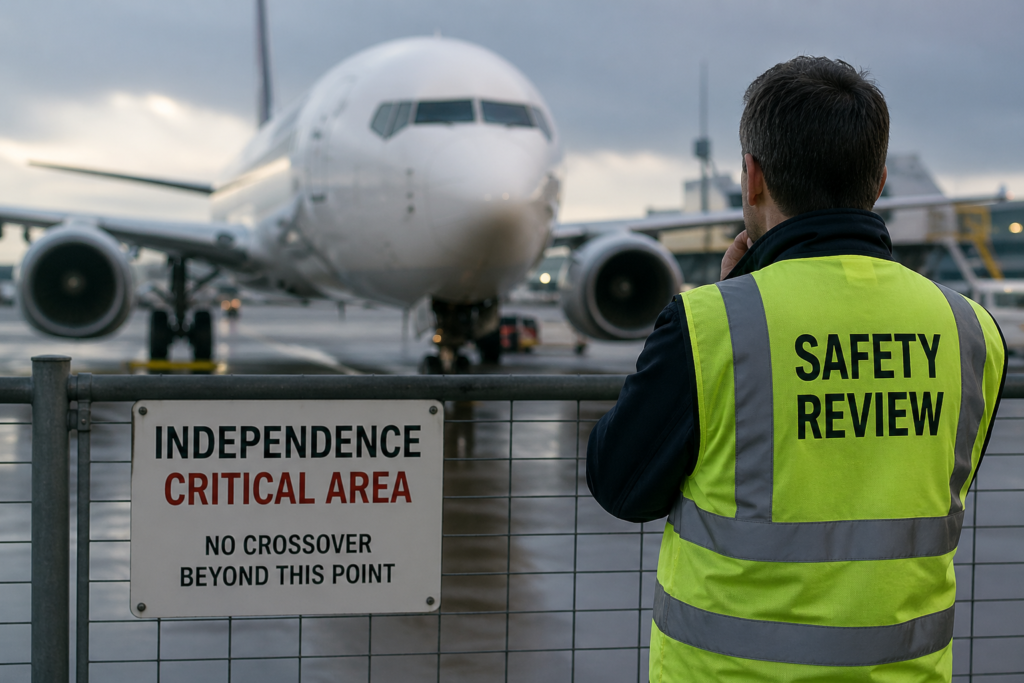
Keeping the fence up
Maintaining independence in practice is less about organisational charts and more about discipline in how roles are exercised under pressure.
The separation only holds if reviewers are not required to help shape or justify the artefacts they are meant to independently assess, because once that feedback loop becomes embedded in the review process, independence begins to erode even if the formal structure remains unchanged.
It also depends on keeping safety analysis outputs, such as FHAs, cleanly separated from program constraints, meaning that assumptions driven by schedule, supplier limitations, or design maturity are clearly identified as context rather than embedded into the safety logic itself.
Most importantly, it requires accepting that independence is not something that is either present or absent, but something that can slowly degrade without ever being formally removed.
Closing thought
Across FAA, EASA, CAA, CASA, and ICAO-aligned systems, the intent behind independence is consistent, and the frameworks themselves are robust in design, but the challenge is that independence is not only a structural property of a system, it is also a behavioural one within it.
And when systems, teams, and programs become tightly coupled over time, the separation that was originally intended to protect objectivity can become increasingly difficult to maintain in practice, even when nothing appears to have changed on paper.
Which leaves a simple but important observation:
independence in aviation safety is not just about who approves what, it is about how far removed they still are from the pressure of how it gets done.