The Event
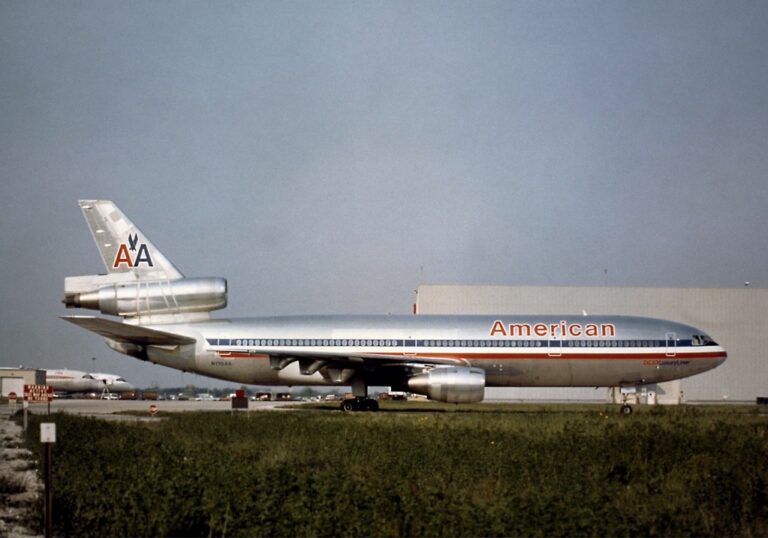
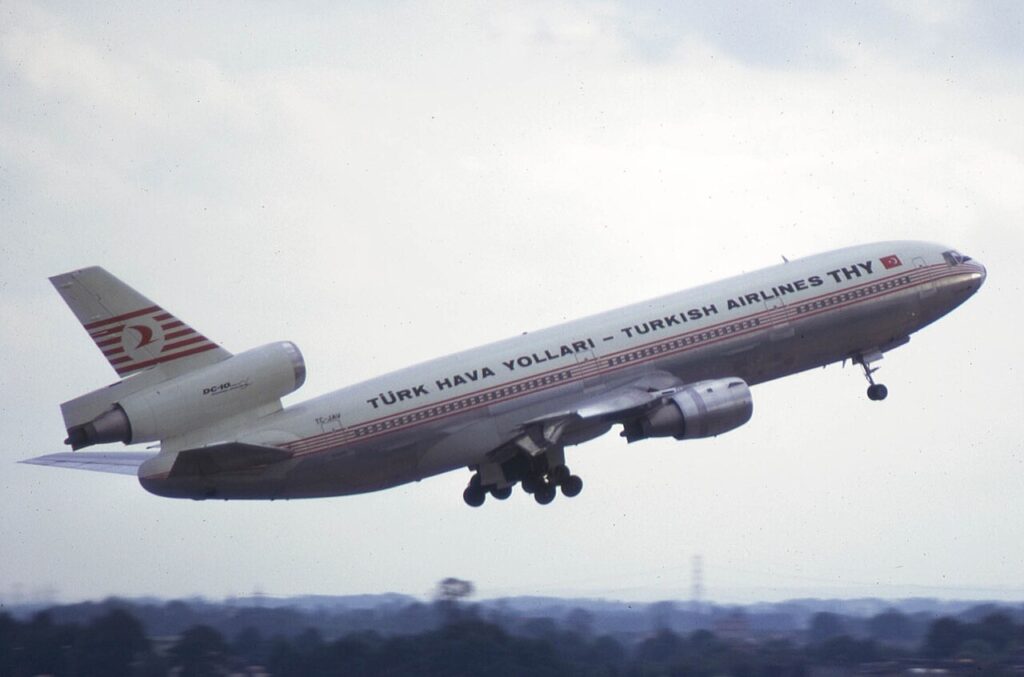
- DC-10 aft cargo door design has a fundamental flaw: the latch handle can be physically forced closed without the locking pins fully engaging
- June 1972: American Airlines Flight 96 — the identical failure mode causes the same door to blow out over Windsor, Ontario
- AA 96 crew recovers the aircraft; all 67 on board survive; failure mode is fully documented
- McDonnell Douglas issues Service Bulletin SB 52-27 recommending modifications
- FAA and McDonnell Douglas agree on a ‘Gentleman’s Agreement’ — no mandatory AD; manufacturer to administer the fix voluntarily
- THY 981 aircraft receives documentation of the modification — but the structural fix (vent hole drilling) is never physically performed
- 3 March 1974: door blows out over Paris; floor collapses; control cables severed
- Aircraft strikes Ermenonville Forest at approximately 760 km/h
- All 346 people on board die — the deadliest accident in aviation history at that time
The Gentleman’s Agreement between the FAA and McDonnell Douglas — a decision to avoid a mandatory Airworthiness Directive — is one of the most consequential regulatory decisions in aviation history.
Systems Engineering Perspective
From a systems engineering perspective, THY 981 demonstrates three distinct and compounding failure modes in the aircraft certification and oversight system: a design that could be misused without obvious consequence, a regulatory framework that allowed manufacturer self-administration of a safety-critical fix, and a physical architecture that made a single door failure catastrophic by routing primary flight control cables through the most vulnerable structural area of the aircraft.
Design defects that can be latently created by normal human action — without requiring any unusual force or deliberate override — are not acceptable in safety-critical systems. The DC-10 cargo door could be improperly latched by a careful, attentive handler following normal procedure.
A Latch That Could Lie
The DC-10 aft cargo door used a complex mechanism in which the locking pins were required to engage before the external handle could be stowed. The physical design allowed a handler to apply sufficient force to the handle to close it past the point where the pins had engaged — creating a false indication of a secured door. The handle appeared stowed. The door appeared closed. The door was not safe.
This is a design that violated the fundamental certification principle that safety-critical configurations must be physically impossible to achieve in an unsafe state without deliberate override. The door could be in a dangerous state through normal, careful operation.
A design that allows a safety-critical component to appear secured when it is not has failed at the most basic level of engineering intent. The appearance of safety is not safety.
The Regulatory Self-Administration Failure
Following the AA 96 incident in 1972, the FAA and McDonnell Douglas entered into what has been described as a ‘Gentleman’s Agreement’ — an informal arrangement under which the manufacturer would administer the correction via a Service Bulletin, without the FAA issuing a mandatory Airworthiness Directive requiring independent verification of compliance.
The distinction is critical. An Airworthiness Directive is a mandatory regulatory instrument. Compliance is legally required and documented. A Service Bulletin is a manufacturer’s recommendation. The Turkish Airlines aircraft had documentation suggesting the modification had been performed. The actual structural change — drilling a vent hole in the door to allow pressure equalisation that would make false-latching physically impossible — had not been performed.
The paperwork existed. The safety did not.
Regulatory oversight that relies on manufacturer documentation of its own compliance is not oversight. It is the delegation of accountability to the party with the greatest commercial interest in minimal corrective action.
Control Cable Routing — Architectural Catastrophe
The DC-10’s primary flight control cables ran through the cabin floor. The cabin floor formed the pressure boundary between the pressurised passenger cabin and the unpressurised cargo hold below. When the cargo door blew out, the pressure differential caused the floor to collapse downward into the cargo hold.
This collapse severed the control cables. A single, externally-caused structural failure — the cargo door separation — had thus propagated through the floor to the flight control system, rendering the aircraft completely uncontrollable. This single-failure path to total loss of control was the consequence of an architectural decision that concentrated flight-critical systems in the most vulnerable area of the aircraft.
Human Factors Perspective
The human factors dimension of THY 981 operates primarily at the organisational and regulatory level rather than the operational crew level. The crew had no opportunity to influence the outcome — the aircraft was uncontrollable within seconds of the door separation. The human failures that mattered occurred two years before the flight, at the desks of regulatory administrators and maintenance managers.
The Ground Handler and the Language Barrier
The Turkish Airlines ramp agent who closed the cargo door at Orly Airport did not read English. The warning placard explaining the correct latching procedure, and the visual check required to confirm pin engagement, was printed only in English. The handler could not read the instruction that was the last procedural barrier between him and the failure mode.
This is an interface design failure compounded by an operational deployment assumption — the assumption that all handlers who would operate this door would be literate in English. That assumption was unreasonable and unverified.
A safety-critical procedure communicated only in a language the operator cannot read is, operationally, a procedure that does not exist.
Normalisation of the Known Risk
Between the AA 96 incident in June 1972 and the THY 981 accident in March 1974, the DC-10 cargo door flaw was known to exist, known to have caused a major incident, and believed by the manufacturer and the FAA to have been corrected. The system had normalised the risk — treated it as resolved — without verifying that the resolution had actually occurred.
This is normalisation of deviation at the regulatory level: the systemic tendency to treat a known risk as managed based on documentation rather than verification.
The Gentleman’s Agreement and Accountability Diffusion
The decision to rely on a voluntary Service Bulletin rather than a mandatory AD diffused accountability without eliminating responsibility. The manufacturer believed the operator had complied. The operator believed the maintenance contractor had complied. The maintenance contractor believed the paperwork was accurate. No single party had verifiable, documented evidence of actual physical compliance.
Distributed accountability without independent verification is, in safety systems, the same as no accountability.
System Interaction Breakdown
1. Known Failure Mode, Absent Mandatory Correction
The door failure mode had been demonstrated in an actual operational incident two years before THY 981. The physical fix was available and understood. Its non-mandatory status meant it was administered through the same documentation process as routine maintenance — without the independent oversight required to verify that a safety-critical modification had actually been performed.
A known, documented, demonstrated failure mode that is corrected by voluntary means has not been corrected. It has been deferred, with the risk transferred to the operators and, ultimately, the passengers.
2. Floor as Single Pressure Boundary and Control Route
The cabin floor served simultaneously as the pressure boundary and the routing path for primary flight control cables. This meant that any failure that breached the pressure boundary also threatened the control system. Two independent safety functions were co-located in a single structural element with no physical separation.
3. Cascade From Single External Event
Door separation → floor collapse → cable severance → total loss of control. The entire cascade was initiated by a single external event — the door opening — and each subsequent step was structurally guaranteed by the aircraft’s design. There was no break in the chain, no redundant system that could interrupt the propagation.
When a single initiating event guarantees a fatal cascade through design, the design has failed — regardless of how improbable the initiating event was assessed to be.
Significance in Aviation Risk
1. Mandatory ADs for Known Structural Defects
THY 981 established the principle that known, demonstrated safety-critical defects must be corrected by mandatory, independently verified Airworthiness Directives — not voluntary manufacturer service bulletins.
2. Physical Verification of Safety Modifications
Regulatory compliance now requires physical verification of critical modifications, not documentation review alone. The ‘placard installed, fix performed’ ambiguity that existed in the THY 981 maintenance record is no longer an acceptable standard of evidence.
3. Control System Routing Architecture
New aircraft designs were required to route primary flight control systems through paths that could not be compromised by cargo hold pressure failures. The co-location of the pressure boundary and the control cable routing in the DC-10’s floor design has not been repeated.
4. Multilingual Safety-Critical Placards
Safety-critical operational instructions for components operated by non-English-speaking ground staff must be available in the operating language of the handler. The English-only placard on the DC-10 cargo door was a direct contributing factor.
Related Aviation Risk Lab Content
Pillar Pages
Systems Engineering: Systems Engineering
Design and Certification: Design And Certification
Maintenance and Airworthiness: Maintenance And Airworthiness
Safety Engineering: Safety Engineering
Related Case Studies
Case Study 5: American Airlines 96 — The Door That Nearly Did It First: AA 96 1972
Case Study 53: American Airlines 191 — The Engine That Took the Slat With It: AA 191
Case Study 25: Lion Air 610 — MCAS and the Single Point of Failure: Lion Air 610
Closing Perspective
Turkish Airlines 981 is aviation’s clearest case study in the cost of treating regulatory compliance as optional. The design was flawed. The fix was available. The regulatory system chose not to mandate it. Three hundred and forty-six people died as a direct consequence of that choice.
The accident established principles that govern aviation certification to this day: that known defects require mandatory correction; that compliance must be independently verified; that safety-critical system designs must be physically resistant to improper configuration; and that the appearance of safety — a completed placard, a signed work order — is not evidence of safety.
The Gentleman’s Agreement that killed 346 people is the reason that agreement no longer exists. It is the reason Airworthiness Directives are binding instruments with legal force. And it is the reason that every critical modification performed on every commercial aircraft must leave a physical trail that can be independently verified.
THY 981 is the reason ‘it’s been documented’ is no longer sufficient evidence of compliance for safety-critical modifications. Verification — physical, independent, documented — is the standard.