The Event
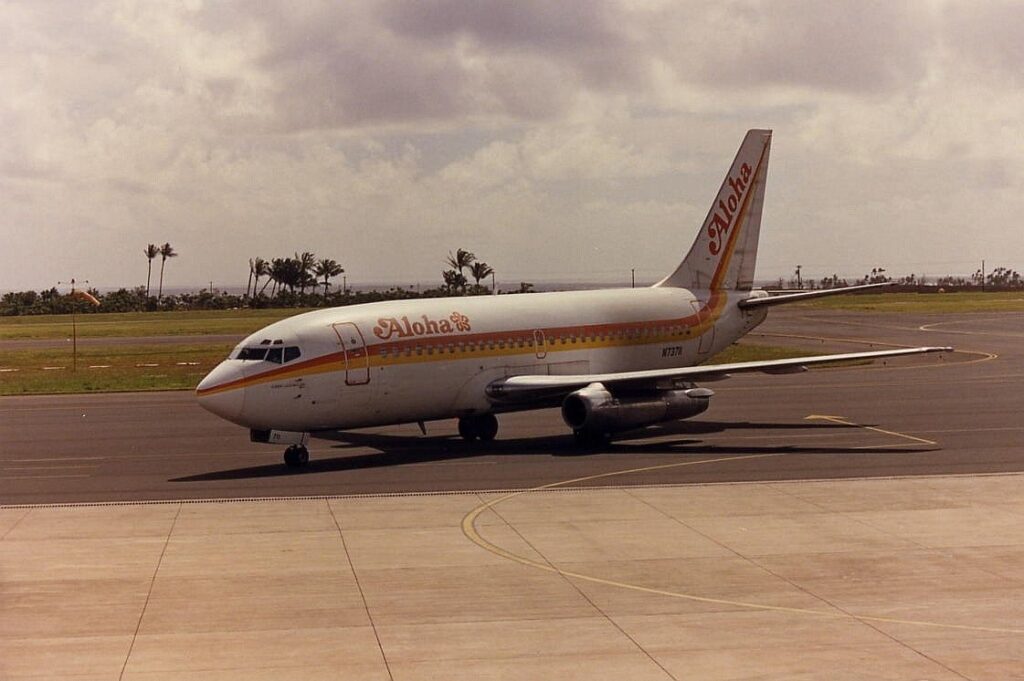
On 28 April 1988, Aloha Airlines Flight 243, a Boeing 737, was cruising between Hawaiian islands.
At altitude, a large section of the fuselage roof suddenly separated from the aircraft.
An explosive decompression occurred instantly.
Despite extreme structural damage, the aircraft remained partially controllable and performed an emergency landing.
One flight attendant was lost.
What Happened (Surface Explanation)
The aircraft had accumulated widespread multi-site fatigue cracking in the fuselage skin.
Contributing factors:
- High-cycle short-haul operations (many pressurisation cycles per day)
- Corrosion in marine environment
- Riveted lap joint design vulnerability
Over time:
- Multiple cracks formed simultaneously across fuselage joints
- These cracks were not individually detectable as critical
Eventually:
- The cracks linked together
- A large structural section separated in flight
The System’s Perspective
From the aircraft’s point of view:
- Pressurisation cycles = normal
- Maintenance inspections = compliant with existing methods
- Structural integrity checks = no single catastrophic defect detected
The system treated the aircraft as a collection of inspectable parts.
But the failure existed at the interaction level between parts.
Where the Situation Became Dangerous
This was not a single-point defect.
It was a distributed structural degradation that escaped detection thresholds.
1. Inspection granularity mismatch
- Inspection methods focused on discrete cracks
- Failure occurred through crack linkage across multiple sites
2. Assumption of independence
- Each structural element was evaluated individually
- System-level coupling effects were not fully captured
3. Progressive connectivity of damage
- Small cracks gradually formed a continuous failure path
- Once connected, structural integrity collapsed instantly
The system failed because damage was not treated as a network phenomenon.
Why the Crew Could Not Anticipate It
From the cockpit:
- No warning indicated imminent structural separation
- Aircraft behaviour remained largely normal until failure moment
- Decompression occurred too rapidly for anticipatory response
There was no “progressive alarm state.”
The system transitioned directly from:
intact → catastrophic rupture
The Critical Transition
The decisive moment occurred when:
- Multiple fatigue cracks reached connectivity threshold
- Structural load redistribution exceeded material tolerance
- Fuselage skin panel detached in-flight
At that point:
- The aircraft lost pressure integrity instantly
- But retained enough structural cohesion to remain airborne
The Deeper Pattern
This was not a maintenance oversight in the traditional sense.
It was a scale mismatch between inspection logic and failure topology:
- Maintenance assumed localized defects
- The real failure mode was distributed and cumulative
- Detection systems were not designed for networked material degradation
The system did not fail because it missed a crack.
It failed because:
It did not model how multiple “acceptable” cracks combine into an unacceptable structure.
What This Case Actually Shows
Aloha 243 demonstrates that:
1. Structural safety is a system property, not a component property
2. Distributed fatigue can bypass local inspection logic
3. Failure can emerge from connectivity, not magnitude
4. Maintenance models must account for interaction between defects
The Core Insight
The aircraft did not fail because a single part broke.
It failed because:
Many small, acceptable defects became one large, unacceptable system state.
From that point:
- No individual inspection point was “wrong”
- But the combined system state was already critical
Final Framing
This was not a sudden structural accident.
It was a failure of inspection scale and system-level fatigue modelling:
- Damage accumulated across multiple locations
- Each location remained within acceptable limits
- But collectively they formed a catastrophic structural condition
The system did not fail at one point.
It failed in the way its parts interacted over time.