The Event
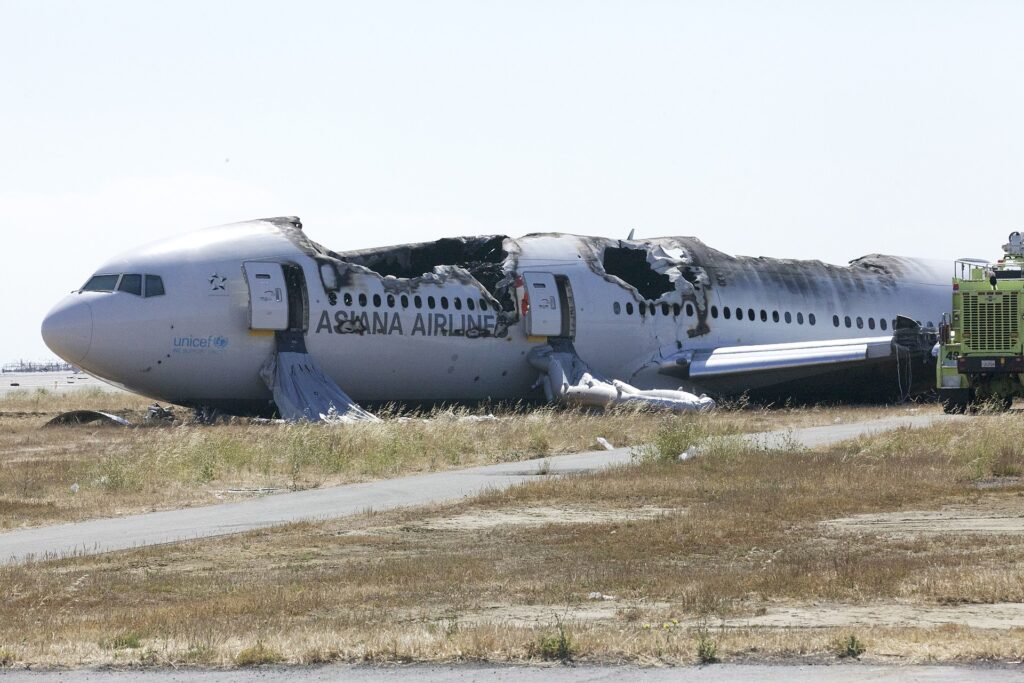
On 6 July 2013, Asiana Airlines Flight 214, a Boeing 777, was on final approach to San Francisco International Airport.
The aircraft descended below the correct glide path and struck the seawall short of the runway.
The tail separated on impact. The aircraft slid down the runway.
Despite the severity of the crash, many survived due to evacuation response.
What Happened (Surface Explanation)
During the final approach, the aircraft was:
- Below the correct glide slope
- At insufficient airspeed
- With autothrottle not actively maintaining target speed
A key misunderstanding developed around automation mode behaviour during the approach phase.
The aircraft was not being actively “held” at the intended energy state.
The System’s Perspective
From the aircraft’s point of view:
- Flight director = providing guidance cues
- Autothrottle = not actively controlling speed in expected mode
- Pilot inputs = adjusting pitch and descent path
Nothing explicitly indicated a single catastrophic failure.
Instead, the system was operating in a partially passive configuration that still appeared active at a glance.
Where the Situation Became Dangerous
The issue was not one incorrect input.
It was a misalignment between expectation and actual automation state.
1. Mode awareness mismatch
- The crew believed speed was being actively managed
- In reality, autothrottle was not maintaining target speed
2. Energy decay without obvious feedback
- Airspeed gradually decreased
- No strong alert indicated loss of energy management
3. Late recognition loop
- Deviation was noticed when recovery margin was already small
The system did not fail loudly.
It drifted silently.
Why the Crew Did Not Correct Earlier
From the cockpit:
- Visual cues suggested a normal approach profile
- Automation appeared engaged
- Speed degradation was not immediately alarming
The key issue was not lack of attention.
It was incorrect mental modelling of system state.
The crew were responding to what they believed the system was doing, not what it was actually doing.
The Critical Transition
The decisive moment occurred when:
- Airspeed dropped below safe threshold for stabilized approach
- Glide path correction was no longer sufficient to regain energy state
- The aircraft crossed from recoverable to unrecoverable landing profile
At that point:
- The system no longer had enough altitude or speed to rebuild a stable approach
The Deeper Pattern
This was not an automation failure in isolation.
It was a human–system interpretation mismatch:
- The system continued operating within its logic
- The crew interpreted that logic incorrectly
- The mismatch persisted until energy margins collapsed
The aircraft did not suddenly become unsafe.
It gradually became less correct than everyone believed it to be.
What This Case Actually Shows
Asiana 214 demonstrates that:
1. Automation mode awareness is critical to safety
2. Systems can behave correctly while being misunderstood
3. Energy state degradation is often non-obvious in stable flight phases
4. Misinterpretation can persist longer than the underlying error
The Core Insight
The aircraft did not lose control.
It lost shared understanding of control state.
From that point:
- The system was doing one thing
- The crew believed it was doing another
- And the difference only became visible when recovery was no longer possible
Final Framing
This was not a sudden crash sequence.
It was a progressive divergence between system behaviour and human perception:
- The aircraft remained flyable
- The automation remained technically functional
- But the interpretation of that functionality diverged from reality
And once that divergence became large enough,
the system could no longer be corrected in time.