The Event
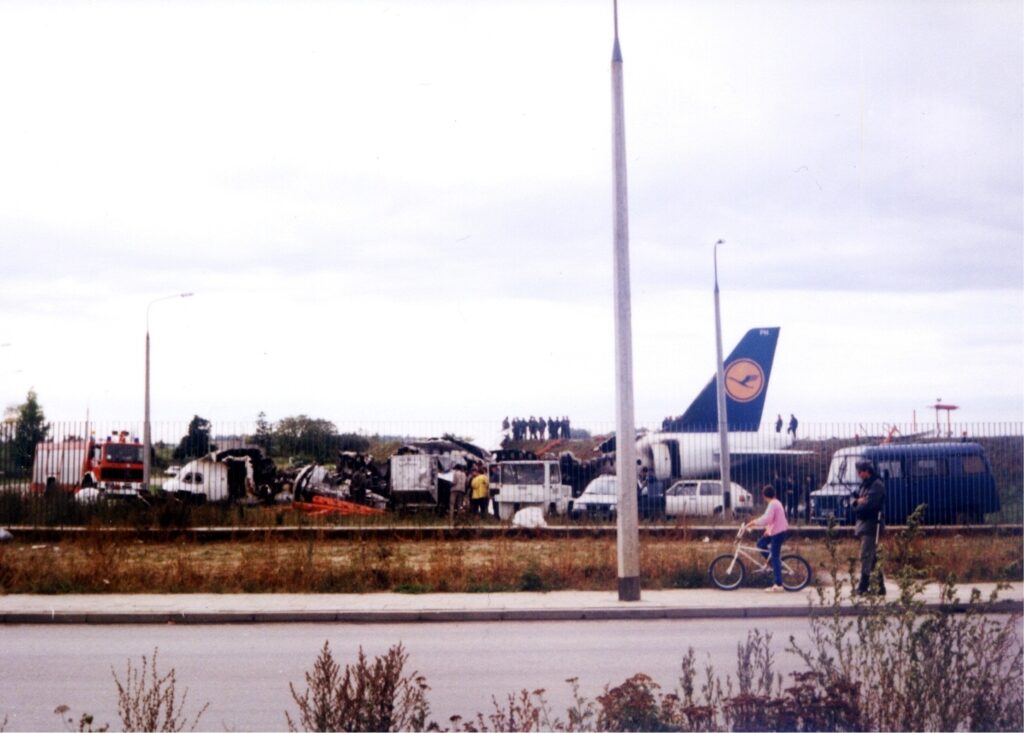
- LH 2904 approaches Warsaw Okęcie in a severe thunderstorm with strong crosswind and heavy rain
- The runway surface is wet; aquaplaning risk is high
- On touchdown in the crosswind, the right main gear touches down marginally before the left
- The spoiler deployment logic requires both main gear WoW switches to be active — both are not simultaneously active
- Spoilers do not deploy at touchdown; aerodynamic braking is absent in the critical first seconds
- The thrust reversers and wheel brakes alone cannot provide sufficient deceleration on the wet runway
- The aircraft exits the end of the runway at approximately 60 knots
- It strikes a bank, catches fire; 2 people die, 54 are injured
The investigation found that the Boeing 737’s spoiler deployment logic required simultaneous activation of both main gear Weight-on-Wheels switches. In crosswind landings, which are routine and expected, it is normal for one main gear to touch down slightly before the other. The design had created a specific, predictable operational scenario in which the spoiler system would not deploy at the designed moment.
Systems Engineering Perspective
From a systems engineering perspective, LH 2904 reveals a logic design that did not account for a normal operational scenario — the crosswind touchdown in which sequential main gear contact is routine. The spoiler deployment system was designed for a perfectly symmetrical touchdown. Real landings, particularly in crosswinds, are not perfectly symmetrical.
A safety system designed for ideal conditions provides no protection in normal operational conditions that deviate from the ideal. Crosswind landings are normal. Sequential main gear touchdown is routine. The design did not account for the real world.
The WoW Logic — Both Gear Must Touch Simultaneously
The Boeing 737’s ground spoiler deployment used Weight-on-Wheels sensors on both main landing gear as a trigger — requiring both to be depressed before the spoilers would extend. The rationale was to prevent inadvertent airborne deployment if one gear briefly contacted the ground in a bounced landing.
This logic was sound for the scenario it was designed to prevent. For crosswind landings — where it is both normal and expected for one main gear to touch down before the other — the logic created a deployment delay. The delay was measurable in seconds. On a wet runway at high groundspeed, seconds of lost aerodynamic braking translate directly into additional stopping distance that the available runway may not provide.
A safety system trigger that requires simultaneous conditions that normal operational scenarios will routinely not provide is a safety system that will fail to activate in those normal scenarios.
Wet Runway Performance — The Margin That Wasn’t
Landing performance calculations on wet runways incorporate a friction coefficient that is lower than dry runway values. The calculation assumes that the deceleration devices — spoilers, thrust reversers, brakes — all operate as designed from the moment of touchdown. When the spoilers are delayed, the actual deceleration in the critical first seconds is significantly lower than calculated.
The performance calculation said the aircraft could stop. The calculation assumed spoiler deployment at touchdown. The spoilers were delayed. The performance calculation was wrong for the conditions that actually occurred.
Landing performance calculations are only valid for the deceleration system performance they assume. When a system that is assumed to function at touchdown is delayed, the calculation’s output is no longer applicable to the actual situation.
Human Factors Perspective
The human factors dimension of LH 2904 is primarily a design logic validation against operational scenarios issue — the crew performed correctly, and the outcome was determined by a design decision made years before the flight.
Crew Performance in Severe Weather
The crew of LH 2904 conducted a professional approach and touchdown in severe crosswind conditions. The touchdown was within normal parameters for a crosswind landing. The decision to continue the approach was consistent with the aircraft’s certified crosswind limits. The crew had no information that the spoiler system was not deploying.
The crew did everything right. The system failed them — not through a malfunction, but through a design that had not been validated against the conditions in which it would operate.
The Operational Scenario That Should Have Been Tested
Crosswind landings are routine, not exceptional. The deployment logic for the 737’s spoiler system should have been specifically validated for sequential main gear touchdown scenarios before certification. If this validation had occurred, the logic could have been designed to activate on single-gear contact rather than both-gear simultaneous contact.
System Interaction Breakdown
1. Both-Gear WoW Requirement — Crosswind Incompatibility
The spoiler logic required simultaneous both-gear WoW activation. Crosswind landings routinely produce sequential activation. The logic was incompatible with a normal operational scenario.
2. Spoiler Delay — Lost Braking in Critical First Seconds
The delay in spoiler deployment removed aerodynamic braking in the critical first seconds after touchdown — the period of highest groundspeed and greatest aerodynamic braking effectiveness.
3. Performance Calculation Invalid for Actual System State
The stopping distance calculation assumed spoiler deployment at touchdown. With delayed deployment, the calculated stopping distance was shorter than the actual distance required.
Performance calculations must reflect actual system behaviour in the specific operational scenario, not designed behaviour in ideal conditions.
Significance in Aviation Risk
1. Boeing 737 Spoiler Logic Modification
Boeing modified the 737 spoiler deployment logic to activate on single main gear WoW contact — eliminating the both-gear simultaneous requirement that had caused the LH 2904 overrun. The modification was applied to the 737 fleet.
2. Wet Runway Performance Recalculation
The relationship between spoiler deployment timing and stopping distance calculations was reviewed, with performance margins adjusted to account for the realistic deployment scenario rather than the ideal one.
3. Crosswind Landing Scenario in System Certification Testing
The accident established that safety-critical system deployment logic must be specifically tested in crosswind landing scenarios, where sequential rather than simultaneous gear contact is the norm.
Related Aviation Risk Lab Content
Pillar Pages
Systems Engineering: Systems Engineering
Design and Certification: Design And Certification
Human Factors: Human Factors
Related Case Studies
Case Study: TAM Airlines 3054 — The Thrust Reverser, the Wet Runway: Tam 3054
Case Study: Air Florida 90 — Ice, Complacency and the Decision Not to Wait: Air Florida 90
Case Study: American Airlines 1420 — Thunderstorms, Speed and the Decision: AA 1420
Closing Perspective
Lufthansa 2904 is the proof that a safety system can work exactly as designed and still fail the people it was designed to protect — when the design has not been validated against the normal operational conditions in which it will be used.
The spoilers worked. The WoW switches worked. The logic worked as programd. The design was wrong — because it required a condition that routine crosswind operations would routinely not provide. Two people died because of a design decision made years before their flight.
The modification that followed — single-gear WoW activation for spoiler deployment — is the correct engineering response. The aircraft’s ground roll begins the moment the first main gear touches down. That is when aerodynamic braking must begin. The design now reflects that reality.
LH 2904 proved that ‘works as designed’ and ‘works safely in normal operations’ are not the same thing. The design must be validated against the operational reality, not the ideal scenario.