

Safety engineering is often treated like a compliance exercise—fill out the hazard logs, tick the boxes, pass the audit. But in reality, it’s something more fundamental:
Safety engineering is the discipline of making failure predictable, visible, and manageable before it becomes operational reality.
Whether you’re designing avionics, maintaining aircraft, or operating within a regulated system, the same principles apply. This article breaks down the core ideas that underpin modern safety engineering—without the jargon overload.
1. Safety is not the absence of failure
One of the most persistent misconceptions in engineering is that “safe” means “nothing fails.”
That is not how real systems work.
Aircraft, control systems, and modern automated platforms do fail. The question safety engineering answers is:
What happens when they fail, and can we survive it?
This shifts the focus from prevention-only thinking to:
- Failure tolerance
- Controlled degradation
- Recoverability
- System resilience
A safe system is not one without failure—it is one where failure does not escalate into catastrophe.
2. Safety is a system property, not a component property
A safe component does not guarantee a safe system.
For example:
- A perfectly reliable sensor can still contribute to a hazardous system state if interpreted incorrectly
- Redundant systems can fail if they share a common dependency (power, software logic, environmental assumptions)
This is why safety engineering operates at the system level, not the part level.
You are not asking:
- “Is this component safe?”
You are asking:
- “Does this system behave safely under foreseeable and unforeseen conditions?”
3. Functions matter more than hardware
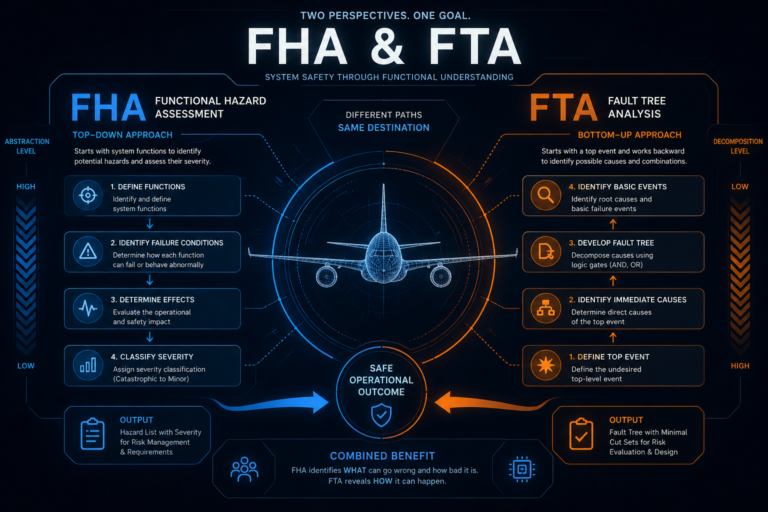
Modern safety analysis starts with functions, not physical parts.
This is the basis of techniques like Functional Hazard Analysis (FHA).
Instead of asking:
- “What if this valve fails?”
We ask:
- “What if pressure regulation is lost?”
This shift matters because:
- Functions can fail in multiple ways (loss, delay, corruption)
- Multiple components can contribute to the same functional failure
- Design decisions must protect outcomes, not just equipment
4. Failure is assumed—not discovered late
A mature safety process does not try to prove that a system will not fail.
It assumes:
- Components will fail
- Humans will make errors
- Software will behave unexpectedly
- Conditions will exceed design assumptions
The goal is to ensure:
- Failures are detected
- Effects are contained
- Recovery paths exist
This is why safety engineering is deeply connected to:
- Redundancy
- Fault detection logic
- Monitoring systems
- Operational procedures
5. Severity matters more than probability (early in design)
In early safety work, we do not start with “how likely is this?”
We start with:
“If this happens, how bad is it?”
A low-probability catastrophic event is often more important than a high-probability minor one.
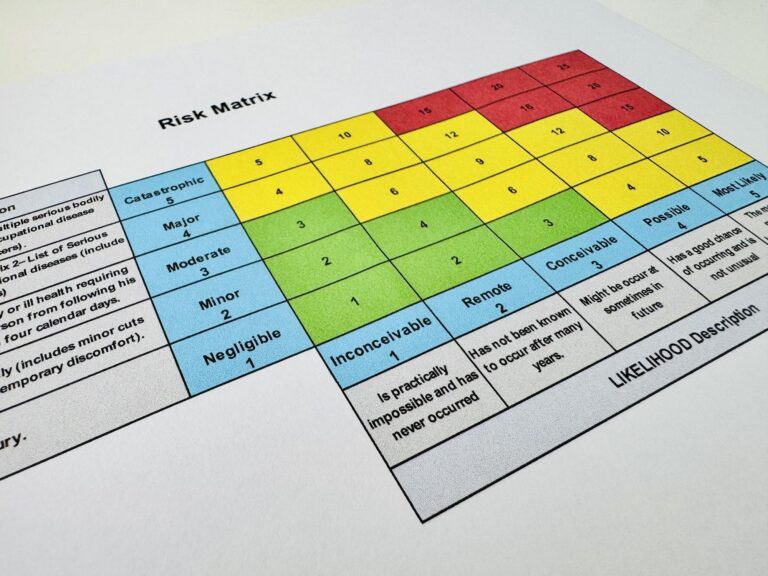
This is why hazard classification frameworks exist:
- Catastrophic
- Hazardous
- Major
- Minor
- No effect
Probability becomes meaningful only after:
- Architecture is defined
- Controls are in place
- Mitigations are understood
6. Safety emerges from layers, not single solutions
No single control makes a system safe.
Instead, safety comes from layered defenses:
- Design controls (architecture, redundancy)
- Detection (sensors, monitoring logic)
- Operational procedures (checklists, training)
- Human factors (interface design, workload management)
- Organizational controls (maintenance schedules, regulations)
This is often described informally as “defense in depth,” but in practice it is more like stacked imperfect barriers that collectively reduce risk.
7. Trade-offs are unavoidable
Every safety decision competes with:
- Cost
- Weight
- Performance
- Complexity
- Maintainability
There is no such thing as absolute safety in engineered systems—only acceptable risk within constraints.
Good safety engineering does not eliminate trade-offs. It makes them:
- Explicit
- Traceable
- Justified
- Reviewable
8. Documentation is not bureaucracy—it is traceability
Safety documentation is often misunderstood as administrative overhead.
In reality, it is how we ensure:
- Design intent is preserved
- Assumptions are visible
- Hazards are tracked through lifecycle changes
- Certification authorities can verify reasoning
Without traceability, systems become unsafe over time—not because they were poorly designed initially, but because they change without understanding the safety impact.
9. The goal is operational safety, not design perfection
A perfectly safe design does not exist.
What does exist is:
- Safe operation under defined conditions
- Managed degradation outside those conditions
- Clear procedures when assumptions are violated
This is why safety engineering extends beyond design into:
- Maintenance practices
- Training and competence
- Operational limitations
- Real-world monitoring and feedback loops
Closing thought
Safety engineering is not about eliminating risk. It is about understanding it deeply enough that no single failure becomes a surprise.
Or more simply:
The goal is not perfection. The goal is controlled imperfection.
Related Posts