The Event
- US 1549 departs LaGuardia Runway 04 in clear weather
- At 2,900 feet, approximately 112 seconds after departure, the aircraft flies through a flock of Canada geese
- Both engines ingest multiple birds and lose all thrust within seconds
- Sullenberger takes the controls; First Officer Skiles begins the dual engine failure checklist
- Sullenberger assesses options — LaGuardia, Teterboro, and the Hudson River
- In approximately 35 seconds, he determines that the Hudson River is the only viable option
- ATC clears the airspace; emergency services are alerted
- Sullenberger executes a controlled ditching at 125 knots
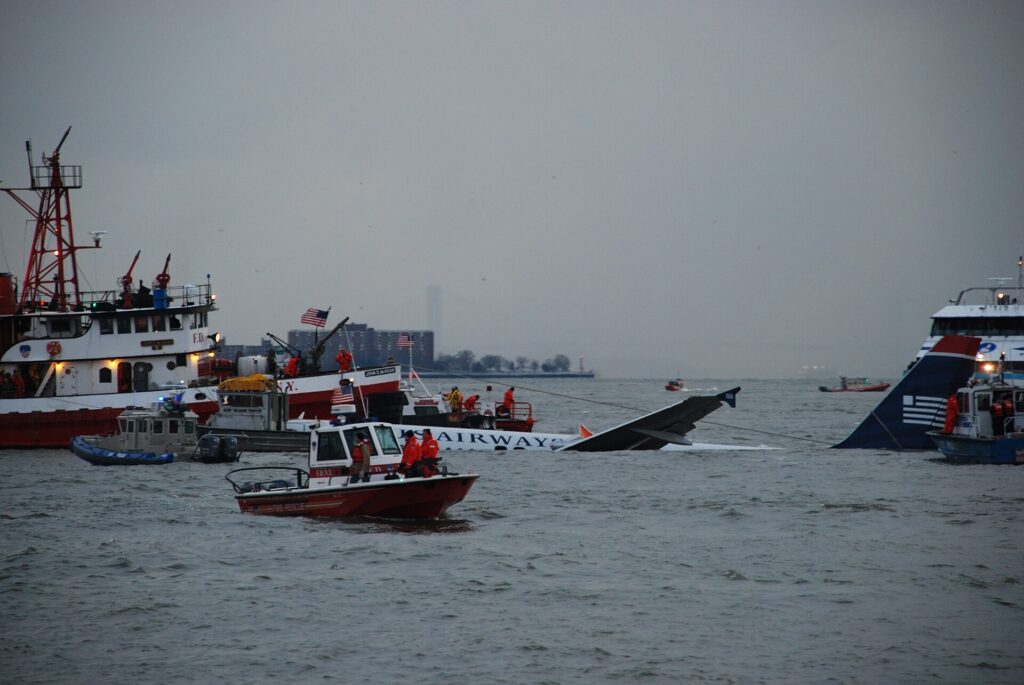
- The aircraft remains structurally intact and floats
- All 155 people are evacuated to rescue vessels; the last passenger is out within 24 minutes
The aircraft touched down on the Hudson River at 15:30:43. The last passenger was pulled from the water at 15:54. The ferry boats, water police, and coast guard units that responded within minutes were not planned for this scenario — they were the normal working complement of an active waterway that happened to be exactly where they were needed.
Systems Engineering Perspective
From a systems engineering perspective, US 1549 is a demonstration of defence-in-depth working at every level simultaneously — aircraft design, training, crew coordination, ATC procedures, emergency services, and chance all aligned to produce survival. It is the Swiss cheese model with no holes aligned.
US 1549 is what aviation’s defence-in-depth system looks like when all the layers hold. Every system performed — the aircraft, the crew, the emergency services, the evacuation equipment, and the ATC response.
Aircraft Design — Built to Be Ditched
The A320’s ditching capability was a design requirement, not an afterthought. The aircraft has a sealed underbelly — no open wheel wells or service openings that would allow rapid flooding. It has a pressurisation hold function that keeps the cabin sealed during water impact. Its floor structure was designed to survive water entry loads. Its life vests were accessible, its emergency exits were functional, and its door seals held against the water.
These design elements were the product of specific regulatory requirements for transport aircraft ditching capability. They were not coincidental. They existed because aviation safety engineering had identified the ditching scenario as requiring specific, engineered preparation.
The A320 stayed afloat for 24 minutes because it was designed to stay afloat. Ditching capability is a design requirement — and on 15 January 2009, it was tested and it worked.
CRM — The Textbook Application
Captain Sullenberger and First Officer Skiles applied CRM at its most fundamental: one pilot flew, one pilot worked the checklist. The roles were clear, the communication was explicit, and neither abandoned their function to help the other. Sullenberger assessed the options and made the decision. Skiles ran the checklist. Both did their jobs simultaneously.
This division of labour — which seems obvious but requires training and discipline to maintain under maximum stress — is the direct product of the CRM philosophy that has been built into commercial aviation training since the late 1970s. It worked exactly as designed.
The Pilot Flying flew. The Pilot Monitoring managed. At maximum stress, in an unsurvivable emergency, the trained role division held. That is the validated proof of CRM.
The Decision — Thirty-Five Seconds of Perfect Aeronautical Judgment
Sullenberger’s decision to ditch in the Hudson River was made in approximately 35 seconds at 2,900 feet. He assessed LaGuardia (too far, wrong direction, insufficient altitude), Teterboro (possible but uncertain, altitude marginal), and the Hudson River (achievable with available energy). He committed to the river.
This decision-making process reflects the highest level of aeronautical decision-making under time pressure: rapid data gathering, explicit option generation, committed execution, no revisiting of the decision once made. It was the product of a lifetime of flying experience and decades of training in exactly this type of decision framework.
Human Factors Perspective
The human factors dimension of US 1549 is entirely positive — it is a documentation of everything that can go right when a trained, experienced, well-coordinated crew operates a well-designed aircraft in an environment where every supporting system functions as intended.
Sullenberger’s Preparation
Sullenberger had spent decades building the specific knowledge base required for this emergency. He was a certified glider pilot. He had studied aviation accidents — he was, at the time of the accident, actively working as an aviation safety consultant. He had practised water ditching concepts. The 208 seconds of the emergency were supported by 40 years of deliberate preparation.
This does not diminish the outcome. It explains it. Exceptional outcomes under exceptional conditions are the product of exceptional preparation.
Sully’s 208 seconds of the emergency were supported by 40 years of preparation. Preparation is the variable that separates survival from non-survival in unsurvivable emergencies.
Cabin Crew Excellence
The five cabin crew members of US 1549 performed a water evacuation with no injuries, in 24 minutes, with no rehearsal. Their performance was the product of specific, required training in water evacuation procedures. Without them, even a perfect ditching could have produced a different outcome in the cabin.
System Interaction Breakdown
1. Bird Strike — No Technical Prevention Available
The bird strike itself represents the one failure in this case for which no available technology provided protection. Bird ingestion certification standards are tested to specific bird sizes and speeds; the Canada geese encountered exceeded the certification test conditions.
2. No Restart — Physics, Not Failure
The crew attempted engine restart. Neither engine recovered. The birds had caused damage beyond the recovery threshold. This was a physical outcome, not a procedure failure.
3. Energy Management — The Perfect Glide
The controlled energy management from 2,900 feet to the Hudson River surface required the crew to manage the aircraft’s energy state within very narrow margins. Too fast at touchdown and the aircraft would skip. Too slow and it would stall. The touchdown was at the correct speed.
The touch down at correct speed was the product of precise energy management from 2,900 feet. Energy management at this level requires skill, experience, and training that are built over decades.
Significance in Aviation Risk
1. Validation of the Safety System
US 1549 is the positive evidence that the aviation safety system works. Every regulation, training requirement, design mandate, and operational standard that produced the outcome of US 1549 was validated on 15 January 2009.
2. Bird Strike Risk Management
The bird strike risk management framework — airport bird hazard control, bird radar systems, and engine certification — was reviewed and strengthened following the accident.
3. Ditching as a Real Scenario
US 1549 elevated water ditching from a theoretical emergency scenario to a proven, viable survival outcome given adequate aircraft design, crew training, and emergency response. It is now a reference case for ditching training worldwide.
Related Aviation Risk Lab Content
Pillar Pages
Crew Resource Management: Crew Resource Management
Systems Engineering: Systems Engineering
Human Factors: Human Factors
Related Case Studies
Case Study 6: United 232 — Hydraulics, Teamwork and the Impossible Landing: United 232
Case Study 20: Air France 447 — When the Automation Stopped: Af 447
Case Study 27: Colgan Air 3407 — Fatigue, Startle and the Stall: Colgan 3407
Closing Perspective
US Airways 1549 is the case that every aviation safety professional should be required to study — not because it shows how to prevent accidents, but because it shows what happens when prevention fails and everything else works.
The pilot was prepared. The aircraft was designed. The crew was trained. The ATC system responded. The emergency services were there. The ferry boats were on the river. Every layer of the safety system held. One hundred and fifty-five people who should have died walked onto the wings of a floating aircraft and got onto boats.
The lesson of US 1549 is not that heroism saves lives. It is that systems save lives — systems built over decades, mandated by regulations, tested by accidents, and improved by every case study in this library. US 1549 is the proof that the investment in safety systems is worth it.
US 1549 is what thirty-five years of aviation safety progress looks like when it is tested. Every survivor is a dividend on that investment.