The Event
- QF 32 departs Singapore Changi Airport on a scheduled service to Sydney
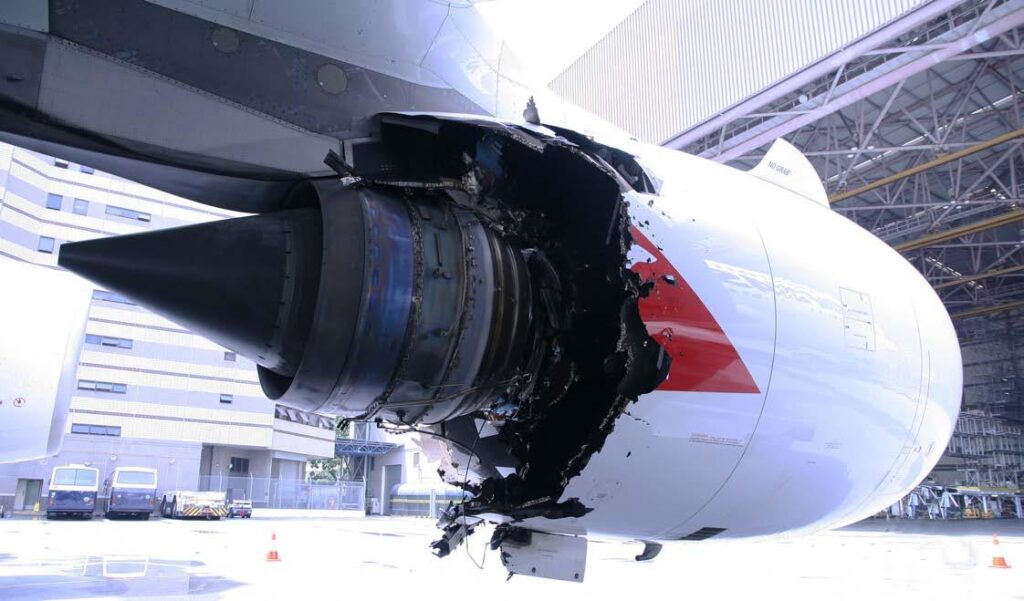
- At approximately 2,200 feet over Batam Island, a loud bang occurs as the Number 2 engine suffers an uncontained failure
- An intermediate pressure turbine disc fragment exits the engine, penetrating the wing, fuel systems, and hydraulic systems
- The ECAM (Electronic Centralised Aircraft Monitor) generates over 50 warning and caution messages
- Fuel is leaking from the left wing; electrical systems are compromised; hydraulic systems are degraded
- The landing gear system is damaged; braking capability is uncertain
- Captain Richard de Crespigny commands a crew of five — two captains and three first officers — in managing the emergency
- The crew spend two hours working through systems, checklists, and performance calculations
- The aircraft lands at Singapore with partial braking and minimum hydraulic pressure
- All 469 people on board survive; the aircraft is damaged beyond economic repair
The Number 2 engine’s intermediate pressure turbine disc had a manufacturing defect — an oil fire in the stub pipe had weakened a component that then failed. Rolls-Royce subsequently identified a manufacturing issue with the oil feed stub pipe and issued modifications for the Trent 900 fleet.
Systems Engineering Perspective
From a systems engineering perspective, QF 32 is the test case for the A380’s redundancy architecture — and the test case that the aircraft passed. The design assumption that multiple simultaneous system failures would not render the aircraft uncontrollable was validated under conditions far more severe than any certification scenario had contemplated.
The A380’s redundancy architecture was not designed for QF 32’s specific failure sequence. It was designed for the general principle that no single failure — and no plausible combination of failures — should render the aircraft uncontrollable. QF 32 tested that principle beyond its design basis. The aircraft held.
The Cascade Failure — How One Disc Fragment Degraded 650 Systems
The disc fragment that exited the Number 2 engine did not produce a clean, isolated failure. It penetrated the wing leading edge, damaged fuel tanks, severed hydraulic lines, cut electrical conduits, and created a debris field that affected multiple aircraft systems. The result was a simultaneous degradation of fuel management, hydraulic pressure, electrical power, braking, landing gear, and spoiler systems.
The ECAM generated approximately 50 warning and caution messages in the first minutes of the event. The crew faced a system state of extraordinary complexity — more than any simulator scenario, more than any emergency checklist anticipated. The design had provided for multiple failures. The design had not specifically provided for this combination of multiple failures.
No checklist can anticipate every combination of failures. The crew of QF 32 worked beyond the boundary of the available checklists using technical knowledge of the aircraft’s systems. This is the argument for deep system knowledge as a crew qualification.
The A380 Redundancy Architecture — Depth of Design
The Airbus A380 was designed with four independent hydraulic systems, multiple electrical power sources, redundant flight control actuators, and a fly-by-wire architecture with significant control surface redundancy. When QF 32’s failure degraded many of these systems simultaneously, the aircraft remained controllable because the redundancy was deep enough — there was always another path, another actuator, another power source.
This is the payoff of defence-in-depth in aircraft design: not that every failure is prevented, but that no failure combination puts the aircraft beyond control. QF 32 tested this principle at the extreme.
Defence-in-depth does not prevent all failures. It ensures that the accumulation of failures does not reach an uncontrollable outcome. QF 32 was the most demanding test of this principle in transport aviation history.
Landing With Degraded Braking — The Engineering Problem
The crew’s most complex engineering challenge was landing a heavily-loaded A380 at Singapore with degraded hydraulic braking, uncertain spoiler deployment, and an unpredictable stopping distance. They had to calculate landing performance without confidence in the available braking deceleration. They chose to burn additional fuel to reduce weight before landing, extend the final approach to use the longest available runway, and mentally prepare for the possibility that the aircraft would not stop on the runway.
The aircraft stopped on the runway. The landing gear structure held. The hydraulic system provided sufficient braking.
Human Factors Perspective
The human factors analysis of QF 32 is a study in high-performance team function under maximum cognitive load — five qualified pilots in a cockpit, managing complexity beyond the scope of any checklist, for two hours, without loss of composure or coordination.
Five Pilots — Task Allocation at Scale
The presence of three additional qualified captains and first officers on the QF 32 flight deck created a crew resource that would not normally be available. Captain de Crespigny allocated the crew explicitly: one captain managed the ECAM; one managed communications; one performed calculations; one flew the aircraft; de Crespigny maintained overall command and situational awareness.
This deliberate, explicit task allocation under maximum cognitive load is the ideal application of CRM principles. The crew did not organically evolve a coordination structure — they created one explicitly, assigned roles, and maintained them throughout the two-hour emergency.
Explicit task allocation is more reliable than organic coordination under maximum stress. QF 32’s crew created structure where the emergency had created chaos.
Beyond the Checklist — Technical Knowledge as a Safety Resource
The ECAM checklists on QF 32 ran out before the failures did. The crew encountered system states that no checklist addressed because no checklist had been written for the specific combination of failures they faced. What kept the aircraft flying was not the checklist — it was the crew’s deep technical understanding of the A380’s systems, allowing them to reason about what each degraded system could and could not do.
This is the argument for deep system knowledge as a component of crew qualification — not just proficiency in normal and emergency procedures, but understanding of the engineering principles that underlie those procedures.
System Interaction Breakdown
1. Single Engine Disc Failure Cascading to 650 System Degradations
The disc fragment’s penetration path through the wing structure produced a cascade of fuel, hydraulic, electrical, and structural failures that exceeded the scope of any emergency checklist.
2. Architecture Holding Under Extreme Load
The A380’s redundancy architecture retained sufficient control authority throughout the emergency to allow a safe landing. The depth of redundancy was tested beyond its design basis and held.
3. Crew Performance Under Maximum Complexity
Five pilots managed a two-hour emergency involving unprecedented system complexity through explicit task allocation, technical knowledge, and coordinated execution.
QF 32 validated three safety systems simultaneously: the aircraft’s redundancy architecture, the crew’s CRM, and the crew’s technical knowledge. All three were necessary. None alone was sufficient.
Significance in Aviation Risk
1. Rolls-Royce Trent 900 Modification
Rolls-Royce identified a manufacturing defect in the oil feed stub pipe of the Trent 900 and issued modifications. The A380 fleet was temporarily grounded pending inspection and modification.
2. A380 Redundancy Architecture Validated
QF 32 provided the most demanding real-world test of the A380’s redundancy design. The aircraft’s performance under conditions of extreme multiple-system failure validated the design philosophy.
3. Deep Technical Knowledge as Crew Qualification
QF 32 demonstrated that deep technical system knowledge — beyond normal and emergency procedure proficiency — is a meaningful safety resource in novel emergencies. This influenced subsequent discussions of pilot qualification and type rating depth.
Related Aviation Risk Lab Content
Pillar Pages
Systems Engineering: Systems Engineering
Crew Resource Management: Crew Resource Management
Maintenance and Airworthiness: Maintenance And Airworthiness
Related Case Studies
Case Study: United 232 — Hydraulics, Teamwork: United 232
Case Study: US Airways 1549 — The River Landing: Usair 1549
Case Study: Air France 447 — When the Automation Stopped: Af 447
Closing Perspective
Qantas Flight 32 is one of aviation’s finest hours — not because nothing went wrong, but because everything that could go wrong did, and 469 people survived. The engine failed. The disc exited. The wing was penetrated. Six hundred and fifty system functions were degraded. And the aircraft landed safely because the design was deep enough, the crew was capable enough, and the knowledge in that cockpit was sufficient.
The lesson of QF 32 is not that the system is perfect. It is that when the system is designed correctly — with sufficient redundancy, with well-trained crews, with deep technical knowledge at the interface between human and machine — it can absorb failures that its designers never specifically anticipated and still bring everyone home.
US Airways 1549 and Qantas 32 are aviation’s two most important positive case studies. Together, they prove that thirty-five years of safety investment is worth every dollar, every hour, and every regulatory mandate that produced it.
QF 32 is the proof that defence-in-depth can absorb a failure cascade that exceeds the design basis — if the depth is sufficient. The A380 had sufficient depth. Six hundred and fifty degraded systems. Zero fatalities.