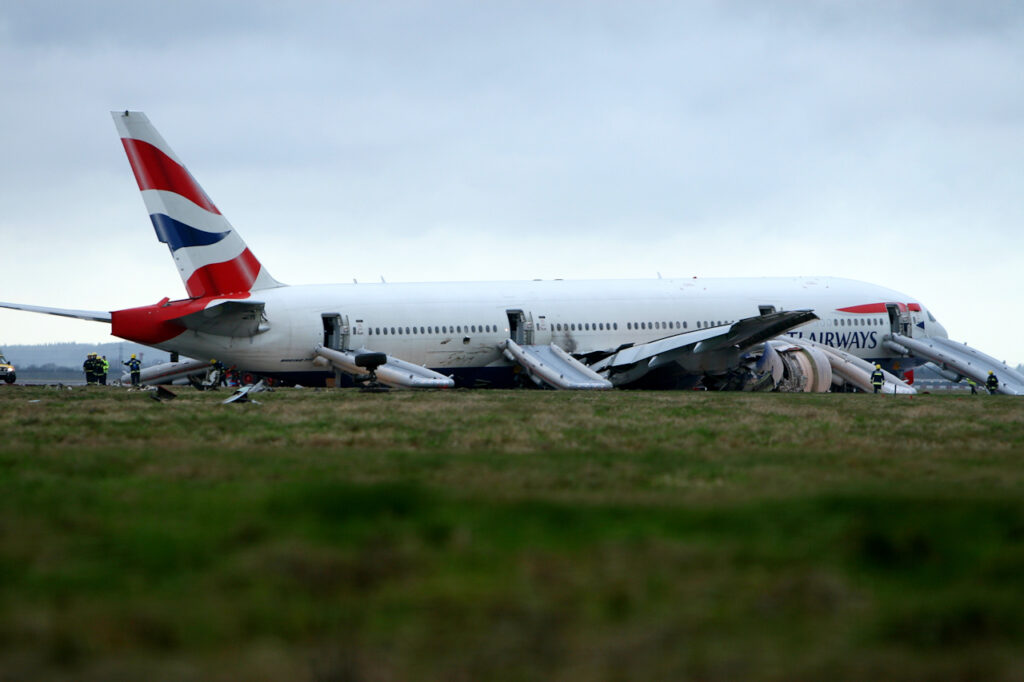
British Airways Flight 38 is often described as a landing accident caused by a sudden loss of engine thrust on approach to Heathrow.
While technically accurate, this description does not capture the system-level behaviour that led to the event.
From a systems perspective, this incident demonstrates how gradual environmental degradation can interact with automated control systems, leading to a sudden loss of thrust response at a critical phase of flight.
Unlike cascading failure events such as Qantas Flight 32, this case illustrates a different pattern:
system performance degradation rather than system cascade failure.
The Event (Overview)
- Boeing 777 approaches Heathrow Airport
- Aircraft encounters severe ice crystal conditions
- Ice accumulates in the fuel/oil heat exchanger system
- Engines gradually lose thrust response capability
- Thrust reduction occurs at low altitude on final approach
- Aircraft lands short of the runway
Despite the severity, there is no post-impact fire and no fatalities.
This event is a direct example of system performance degradation under environmental stress.
Unlike failures that propagate across multiple subsystems, this event involved a hidden internal constraint within the propulsion system.
Key system behaviours:
- ice formation within fuel/oil heat exchanger
- restricted fuel flow under high-demand conditions
- delayed manifestation of system degradation
- loss of thrust response at a critical phase of flight
The important systems insight is:
failure was not sudden—it was latent, progressive, and only became visible under high thrust demand.
This reflects a key principle in aviation systems engineering:
- not all failures are explosive
- some failures emerge gradually until a threshold is crossed
Human Factors Perspective
This event strongly relates to operational Human Factors under normal workload conditions.
The crew experienced:
- normal approach workload initially
- unexpected reduction in thrust response
- rapidly changing flight path energy state
- limited time to diagnose system behaviour
Key Human Factors elements:
Situational Awareness Transition
The crew had to rapidly shift from:
stable approach → degraded energy state awareness
Decision-Making Under Time Compression
At low altitude, available time for diagnosis and correction was extremely limited.
Expectation Mismatch
The aircraft behaviour did not match expected engine response models, increasing cognitive strain.
This highlights a key Human Factors principle:
performance breakdown often occurs when system behaviour deviates from expected mental models.
System Interaction Breakdown
1. Latent system degradation
The ice accumulation did not immediately affect performance.
Instead, it created a hidden constraint that only manifested under high thrust demand.
2. Delayed failure visibility
Unlike cascade failures, this event had no obvious early warning.
System degradation remained invisible until a critical phase of flight.
3. Automation expectation mismatch
The crew’s expectation of engine response did not match actual system output under degraded conditions.
This created a gap between:
- perceived system capability
- actual system capability
Significance in Aviation Risk
British Airways Flight 38 is significant because it demonstrates:
1. Not all failures are cascading
Some failures are slow-developing and latent.
2. System degradation can be invisible
Performance loss may not present clear early warnings.
3. Human response is constrained by system feedback
Crew action is shaped by how system state is presented.
Related Aviation Risk Lab Content
Pillar Pages
Related Case Studies
Closing Perspective
British Airways Flight 38 demonstrates that aviation risk is not only defined by cascading system failures, but also by latent degradation that emerges only under specific operational conditions.
This case complements Qantas Flight 32 by showing the opposite end of the system failure spectrum:
cascade failure vs hidden degradation.
Together, they define how complex aviation systems fail in fundamentally different ways depending on interaction dynamics, not single causes.