The Event
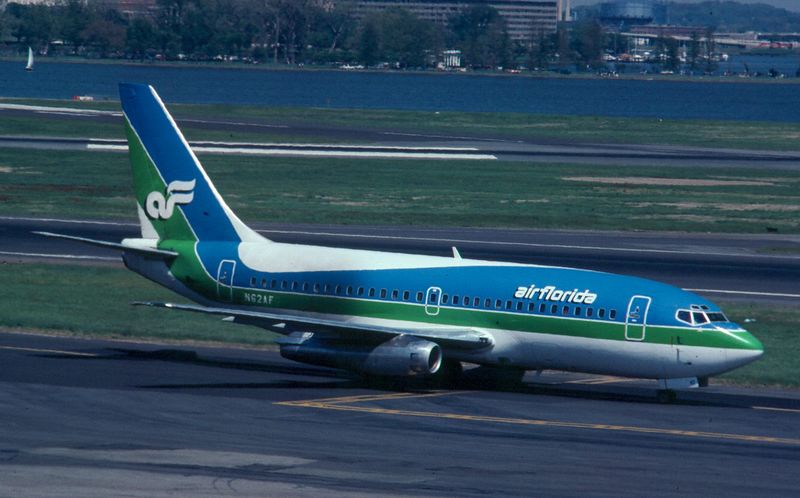
- AF 90 undergoes a single de-icing treatment and then holds on the ground for 49 minutes awaiting departure clearance
- During the hold, snow and ice re-contaminate the wing upper surface — the crew observes this
- The crew does not request a second de-icing treatment
- Engine anti-ice switches are not activated despite icing conditions — a critical error
- Iced engine inlet probes cause EPR gauges to over-read, suggesting more thrust than is actually set
- On the takeoff roll, the first officer observes ‘something’s not right’ about the instrument readings
- The captain acknowledges the concern and continues the takeoff
- After rotation, the aircraft fails to climb normally — consistent with contaminated wing aerodynamics
- At 352 feet, the aircraft strikes the 14th Street Bridge across the Potomac River
- The aircraft plunges into the frozen river; 78 people die; 5 survivors are rescued
One of the five survivors, flight attendant Kelly Duncan, was rescued from the icy water by a fellow survivor who repeatedly swam back into the river to retrieve other passengers. Passersby also assisted; one bystander was later awarded the Coast Guard’s Meritorious Public Service Award.
Systems Engineering Perspective
From a systems engineering perspective, Air Florida 90 represents a failure across three distinct safety layers: the de-icing system (inadequate hold protection and no second application), the engine instrumentation system (EPR over-reading due to iced probes with anti-ice off), and the crew decision-making system (the first officer’s concern not being translated into action).
Air Florida 90 is not the story of one failure. It is the story of three failures that each had the independent potential to prevent the accident — and that each failed.
De-icing Hold-Over Time — A Limit That Didn’t Exist
In January 1982, de-icing holdover time limits — the defined period within which a de-icing treatment provides protection before reapplication is required — were not codified as mandatory operational limits for airline operations. They existed as general guidance, but their translation into binding operational requirements had not occurred.
The crew of Air Florida 90 observed ice and snow re-accumulating on the wing during their 49-minute ground hold. They did not request a second treatment. This decision was not made against a binding regulatory requirement that they were violating — the binding requirement did not yet exist. It was made against a general understanding of the risk that was insufficient to compel action.
A de-icing holdover time limit that is guidance rather than a binding operational requirement is a standard that can be — and will be — set aside under schedule pressure.
Engine Anti-Ice Off — False Performance Indication
The Boeing 737’s engine pressure ratio (EPR) gauges use inlet pressure probes to measure engine performance. In icing conditions, these probes can ice over if the anti-ice system is not activated. When they ice over, they provide a falsely high EPR reading — indicating more thrust than the engine is actually producing.
On the takeoff roll of AF 90, the EPR was over-reading. The crew set what they believed was the correct takeoff thrust. The actual thrust was significantly lower. This is a system providing false performance assurance — the crew believed they had adequate thrust because the instruments said they did. The instruments were wrong because the anti-ice was off.
An instrument that provides false assurance of adequate performance is more dangerous than an instrument that provides no reading. False assurance removes the motivation to investigate.
The First Officer’s Unreceived Warning
The first officer’s observation — ‘something’s not right’ — was transmitted directly and clearly. It was a factual concern about the instrument readings. It was heard by the captain, acknowledged, and not acted upon. The takeoff continued.
This exchange is one of the most-studied in aviation CRM history. The first officer’s language was direct enough to convey concern. It was not direct enough to constitute an unambiguous command to stop. The system needed a mechanism to translate that concern into a mandatory response — to make a stated safety concern from the first officer something the captain was required to act upon, not merely permitted to ignore.
Human Factors Perspective
The human factors dimension of Air Florida 90 is one of pre-decision commitment — the psychological entrenchment in a course of action that makes alternative options increasingly difficult to consider as the sequence progresses. Each step toward the takeoff roll increased the psychological cost of stopping and correspondingly decreased the perceived need to stop.
Plan Continuation Bias
By the time the aircraft reached the takeoff roll, the crew had invested 49 minutes in waiting for departure, one de-icing treatment, and a sequence of taxi and runway operations. The sunk cost of effort and the social momentum of the departure sequence combined to make the decision to stop feel disproportionately costly relative to the apparent risk.
Plan continuation bias — the tendency to continue a course of action despite evidence that it should be stopped — is one of the most frequently identified human factors in aviation accidents. It is most powerful when the evidence for stopping is ambiguous (as ice on a wing can appear to be), when the cost of stopping is visible and immediate, and when the cost of not stopping is probabilistic and deferred.
The cost of stopping was visible: delay, paperwork, inconvenience, commercial pressure. The cost of not stopping was invisible: it was a probability. Human decision-making systematically underweights probabilistic costs against certain ones.
The Two-Challenge Rule
Following Air Florida 90, the Two-Challenge Rule was incorporated into CRM training as a structured response to the scenario where a first officer’s concern is not actioned by the captain. Under the rule, the first officer is trained to assert the concern a second time, more directly, if the first assertion produces no action. If the second assertion also fails to produce action, the first officer is empowered to physically intervene.
This rule transforms the first officer’s role from observer of the captain’s decision to an empowered participant in it — a direct response to the passive concern that could not prevent the accident on the 14th Street Bridge.
Normalisation of the Visible Risk
The crew saw the ice on the wing. They did not treat what they saw as a mandatory stopping condition. This reflects the human tendency to normalise visible risks when previous exposures to the same visible condition have not produced consequences. If previous flights had been de-iced and had held briefly without incident, the visible ice accumulation during this hold may have felt familiar rather than alarming.
System Interaction Breakdown
1. Three Sequential Safety Failures
The de-icing treatment expired; the anti-ice was not activated; the first officer’s concern was not actioned. Any one of these, independently corrected, would have prevented the accident. None was.
A system with three independent safety opportunities, all of which fail, is a system in which each safety layer was insufficient on its own.
2. Instrumentation Producing False Assurance
The EPR over-reading gave the crew false confidence that they had adequate takeoff performance. False assurance is a more dangerous failure mode than a missing indication — it actively suppresses the motivation to investigate.
3. Schedule Pressure Creating Go-Bias
The 49-minute ground hold had already caused significant schedule disruption. Commercial pressure for departure created a systematic go-bias that increased the psychological cost of the decision to wait for a second de-icing treatment.
Schedule pressure is a safety-system input, not an external factor. When it consistently biases crews toward go decisions in marginal conditions, it is a structural safety failure of the operational system.
Significance in Aviation Risk
1. Mandatory Holdover Time Tables
De-icing holdover time limits became mandatory operational requirements — not guidance — for all commercial aircraft operations in icing conditions. These limits are now published by the Association of American Railroads and Transport Canada and are binding on departure planning.
2. Clean Aircraft Concept
The ‘Clean Aircraft Concept’ was formalised: no aircraft may depart with visible frozen contamination on critical surfaces, regardless of the perceived quality of the contamination. The visual check immediately before takeoff became a mandatory operational requirement.
3. Engine Anti-Ice Mandated in Icing Conditions
Anti-ice system activation requirements in icing conditions were strengthened and incorporated into mandatory operating procedures, specifically addressing the EPR over-reading failure mode.
4. Two-Challenge Rule in CRM
The Two-Challenge Rule became a standard element of CRM training globally — providing a structured, procedurally mandated mechanism for first officers to escalate unactioned safety concerns.
Related Aviation Risk Lab Content
Pillar Pages
Human Factors: Human Factors
Weather and Environment: Weather And Environment
Crew Resource Management: Crew Resource Management
Related Case Studies
Case Study 15: USAir 405 — The Contaminated Wing at LaGuardia: Usair 405
Case Study 16: Air Ontario 1363 — Ice, Politics and the Go Decision: Air Ontario 1363
Case Study 3: United 173 — The Hierarchy of Silence: United 173
Closing Perspective
Air Florida 90 gave aviation three of its most important operational safety requirements: mandatory holdover time tables, the Clean Aircraft Concept, and the Two-Challenge Rule in CRM. These requirements exist because three sequential safety opportunities failed on the afternoon of 13 January 1982.
The ice was visible. The EPR was wrong. The first officer was concerned. Any one of these signals, correctly actioned, would have kept 78 people alive. The system needed structural responses that removed the option of acting incorrectly — binding time limits, mandatory anti-ice activation requirements, and a CRM framework that made the first officer’s concern impossible to ignore.
Winter operations today are fundamentally safer because of what happened on the 14th Street Bridge. The holdover tables that every de-icing operation uses, the clean aircraft checks that every crew performs, and the assertiveness frameworks that every CRM programme teaches are all, at their root, the direct legacy of Air Florida 90.
Air Florida 90 is the reason holdover times are binding limits and not guidelines. The difference between a guideline and a limit is the difference between 78 deaths and a delayed departure.