The Event
- TWA 800 sits on the JFK tarmac for several hours in summer heat
- The centre wing tank is nearly empty — used to feed the engines during ground operations
- Air conditioning packs mounted below the CWT have significantly elevated the tank temperature
- The CWT vapour is within the explosive range — a condition that occurs routinely on the 747 in these operating conditions
- Fuel quantity indicating system (FQIS) wiring inside the tank experiences an arc fault
- The arc ignites the CWT vapour at 13,700 feet
- The explosion destroys the forward section of the aircraft
- The nose section separates; the remaining aircraft briefly climbs before falling into the sea
- All 230 on board die — the investigation takes four years and is one of the most complex in NTSB history
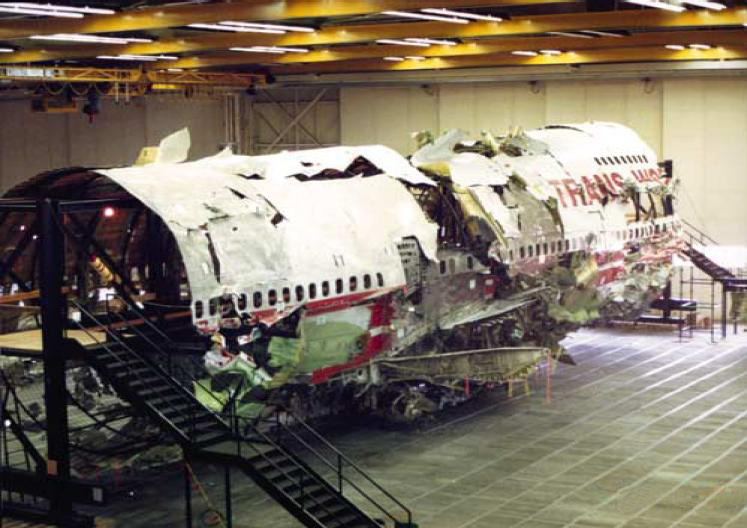
The NTSB investigation recovered approximately 95% of the aircraft from the seabed and physically reconstructed it in a hangar. The four-year investigation was the most extensive in NTSB history to that date.
Systems Engineering Perspective
From a systems engineering perspective, TWA 800 exposes the critical gap between hazard identification and hazard mitigation. The CWT explosion hazard had been identified following two previous events. The ignition source — FQIS wiring carrying voltage within the tank vapour space — had been analysed. The corrective action — either inerting the tank or removing the ignition source — had not been mandated.
A hazard that has been identified but not eliminated remains a hazard. Documentation of a risk is not the same as mitigation of a risk.
The Hot, Nearly-Empty Centre Wing Tank
The 747’s centre wing tank sits between the two wing fuel tanks and beneath the passenger cabin. In normal long-range operations, it carries significant fuel throughout the flight. In shorter operations or after ground hold with engines running, it may be nearly empty.
An empty tank presents a greater explosion risk than a full one, because a full tank has minimal vapour space. A nearly-empty tank in warm ambient conditions can contain a vapour-air mixture within the explosive concentration range — rich enough to ignite but not too rich to sustain combustion. The air conditioning packs mounted directly below the CWT heat the tank further, concentrating the vapour.
This operating condition — near-empty CWT with hot ground operations — was not unusual. It occurred routinely. The fuel state and temperature were not abnormal. The risk was structural and operational, not coincidental.
The explosive vapour condition in the CWT was not unusual. It was a predictable, routine consequence of normal 747 operations in warm conditions. Routine operating conditions that create explosion risk are not acceptable design features.
FQIS Wiring Inside the Tank — An Ignition Source by Design
The FQIS wiring ran through the fuel tanks to measure fuel quantity. The wiring carried sufficient voltage, under fault conditions, to produce a spark capable of igniting fuel vapour. The design incorporated the fundamental assumption that the wiring would not arc.
Under normal conditions, this assumption was valid. Under degraded conditions — chafed insulation, moisture contamination, a single insulation failure anywhere in the system — the assumption was not valid. The certification had accepted the presence of an ignition-capable energy source inside a fuel tank vapour space on the basis of an assumption about the reliability of the insulation.
Placing wiring that carries ignition-capable voltage inside a fuel tank vapour space, and assuming the wiring will not arc, is a design that depends on a component never failing. That is not a safe design assumption.
Three Events, No Mandatory Action
The Thailand and Philippines 747 CWT events in 1990 had been investigated. The investigation findings included analysis of the potential for ignition within the CWT. Service information was issued. No mandatory airworthiness directive requiring fleet-wide corrective action was issued.
The sequence — event, investigation, documentation, no mandatory action, second event, investigation, documentation, no mandatory action, third event killing 230 — is a failure of the safety management system to translate identified risk into mandatory corrective action.
Human Factors Perspective
The human factors dimension of TWA 800 is primarily a regulatory and organisational story. The operational crew had no opportunity to influence the outcome — the failure was structural and instantaneous. The human failures that mattered were in the offices of the FAA and Boeing where the risk was known, documented, and not acted upon with sufficient urgency.
The Safety Data Aggregation Failure
The TWA 800 risk was visible in the safety data — in the investigation reports of two previous CWT explosion events. What the system lacked was a mechanism for aggregating this information across events and translating it into mandatory preventive action. Each event was investigated in isolation. The pattern was not assessed. The fleet-wide risk was not recognised as requiring fleet-wide mandatory action.
Safety data that exists in individual event reports but is not aggregated across events is not fleet intelligence — it is an archive of missed opportunities.
Regulatory Inaction on Identified Hazard
The FAA’s decision not to issue a mandatory airworthiness directive following the 1990 CWT events reflected a regulatory process that weighted the probability of recurrence against the cost of mandatory action. TWA 800 showed what the cost of inaction was. The lesson was that identified, physically plausible hazards in high-consequence systems require mandatory corrective action, regardless of assessed recurrence probability.
System Interaction Breakdown
1. Routine Operating Condition Creates Explosive Hazard
The near-empty, heated CWT was a routine operating condition. The explosive vapour concentration it created was a known consequence. A design that creates an explosive hazard under routine operating conditions contains a structural safety failure that cannot be managed by operational controls alone.
Hazards created by normal operation cannot be managed by abnormal procedures. They must be eliminated by design.
2. Ignition Source Inside Tank Vapour Space
The FQIS wiring inside the tank carried ignition-capable voltage. Its safety depended on the wiring never faulting. Component-level reliability is not a sufficient safety basis for eliminating an ignition source from an explosive atmosphere.
3. Three-Event Pattern Without Mandatory Response
Two documented CWT explosion events, followed by a third killing 230 people, is the consequence of a safety management system that did not treat a pattern of identical events as a fleet-wide mandatory safety concern.
A second occurrence of a first event is not a coincidence — it is evidence that the first event’s corrective action was insufficient.
Significance in Aviation Risk
1. Fuel Tank Inerting Mandated
The most significant post-TWA 800 regulatory change was the FAA’s mandate for fuel tank inerting — using an onboard nitrogen generation system to replace the ullage oxygen in the CWT with inert nitrogen, preventing explosive vapour formation. This was the engineering solution that eliminated the hazard at source.
2. FQIS Wiring Standards Revised
FQIS wiring standards were revised to eliminate ignition-capable voltage sources within fuel tank vapour spaces, replacing them with intrinsically safe designs.
3. Safety Data Aggregation Framework
The TWA 800 investigation drove the development of improved safety data aggregation processes within the FAA, aimed at identifying patterns across events that individual investigation reports might miss.
Related Aviation Risk Lab Content
Pillar Pages
Systems Engineering: Systems Engineering
Design and Certification: Design And Certification
Safety Engineering: Safety Engineering
Related Case Studies
Case Study 12: Swissair 111 — The In-Flight Fire: Swissair 111
Case Study 17: ValuJet 592 — The Oxygen Generators: Valujet 592
Case Study 42: China Airlines 120 — The Fuel Leak: China Airlines 120
Closing Perspective
TWA Flight 800 is the most consequential of the three centre wing tank explosion events not because it was the worst engineered but because it was the most preventable. The hazard had been identified. The ignition source was known. The corrective action was available. Two hundred and thirty people died because the regulatory system had not treated an identified, documented, plausible hazard as requiring mandatory fleet-wide action.
The fuel tank inerting systems that now prevent CWT explosions on modern aircraft exist because of TWA 800. The FQIS wiring standards that eliminate ignition sources from tank vapour spaces exist because of TWA 800. The safety data aggregation processes designed to identify patterns across events exist, in part, because of TWA 800.
The price of those systems was 230 lives. The obligation is to ensure that identified hazards in high-consequence systems are treated as mandatory — not discretionary — corrective action items, regardless of assessed recurrence probability.
TWA 800 is the case that established the principle: an identified, physically plausible hazard in a high-consequence system requires mandatory corrective action. Probability is not a substitute for engineering.