The Event
- Three days before the accident, maintenance performs a task on the right wing slat mechanism
- During the task, a fastener is inadvertently driven through the leading edge fuel tank
- The puncture is not detected post-maintenance; the aircraft is released to service
- The aircraft completes three subsequent flights with a slow fuel leak developing
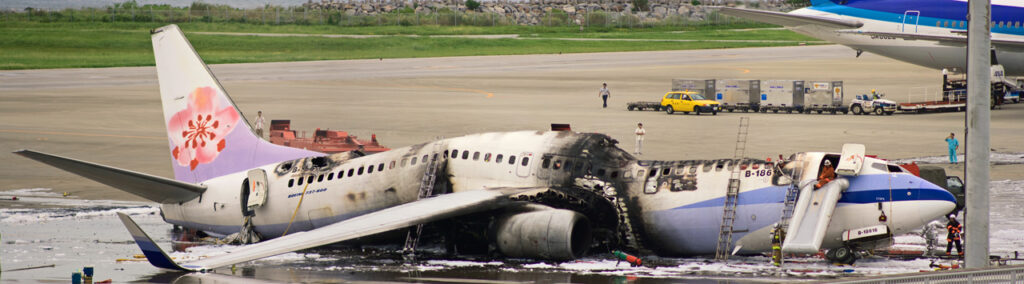
- 20 August 2007: After landing and parking at Gate 6 Naha Airport, a fuel leak is visible under the wing
- Before action can be taken, the leaked fuel ignites
- Within 90 seconds the right wing is fully engulfed
- Cabin crew initiate emergency evacuation; all slides deploy correctly
- All 165 passengers and crew evacuate the aircraft before the fire reaches the cabin
- The aircraft is completely destroyed by the subsequent fire
The fire’s progression from ignition to complete aircraft destruction in approximately five minutes demonstrates the speed at which a fuel-fed aircraft fire can develop. The survival of all 165 occupants is attributable to the cabin crew’s immediate initiation of evacuation and the correct functioning of all emergency exits and slides.
Systems Engineering Perspective
From a systems engineering perspective, CI 120 presents a post-maintenance quality assurance failure in which a maintenance-induced damage to a fuel-critical system component went undetected through the task completion inspection and through three subsequent flight cycles, creating a slow fuel leak that eventually produced a catastrophic apron fire.
A maintenance action that creates fuel system damage requires post-maintenance inspection that is specifically calibrated to detect that type of damage. Generic inspection of the completed task does not substitute for specific verification that the adjacent fuel system is intact.
Fastener Intruding Into Fuel Tank — Detection That Wasn’t
The leading edge slat mechanism maintenance task involved fastener installation in proximity to the leading edge fuel tank. The specific geometry of the wing leading edge in this area meant that an improperly directed fastener could penetrate the tank wall — a failure mode that is specific, predictable, and detectable by post-maintenance inspection.
The inspection performed after the maintenance task was a general task completion check — verifying that the maintenance work had been completed, not specifically verifying that the adjacent fuel tank had not been damaged. The specific post-task check required to detect this failure mode was absent.
Post-maintenance inspection must be calibrated to detect the specific failure modes associated with the maintenance task performed — not just to verify that the task is complete.
Three Flights With a Developing Leak
The aircraft completed three flights after the maintenance task before the fire. During those three flights, the fuel leak existed and was developing. Pre-flight walkaround inspections did not detect it. In-flight fuel quantity monitoring did not detect the imbalance at the level of the early leak. Post-flight inspection did not detect it.
The leak rate was below the detection threshold of available monitoring. The physical inspection was not specifically looking for fuel drips from the leading edge area following this maintenance task.
Human Factors Perspective
The human factors analysis of CI 120 is primarily a study in maintenance task-specific inspection design and the broader principle that quality assurance cannot be generic — it must be calibrated to the specific risks associated with specific tasks.
The Evacuation — Cabin Crew Saving Everyone
The survival of all 165 occupants is a positive human factors outcome that must be documented alongside the negative maintenance failure. The cabin crew initiated evacuation immediately and effectively. Every exit functioned. Every slide deployed. Every occupant escaped before the fire penetrated the cabin.
This outcome validates the mandatory cabin crew emergency training, the aircraft emergency exit design standards, and the 90-second evacuation certification requirement.
The 90-second evacuation certification requirement exists precisely for scenarios like CI 120. It was tested in a real fire, with real passengers, in real conditions. It worked.
Maintenance Documentation for Proximity Damage
The maintenance engineer who performed the slat task had no specific reason to believe a fastener had penetrated the fuel tank. The task was routine. The damage was not visible from the maintenance access position. The detection gap was structural — the inspection programme did not require a fuel system check following this specific task.
System Interaction Breakdown
1. Maintenance-Induced Damage Not in Post-Task Inspection Scope
The post-maintenance inspection covered the completed slat task, not the adjacent fuel system integrity.
2. Three Pre-Fire Flights — Missed Detection
Three flight cycles with a developing fuel leak provided opportunities for detection that were not exploited by available monitoring systems.
Significance in Aviation Risk
1. Task-Specific Post-Maintenance Inspection
Post-CI 120, inspection requirements following maintenance tasks on the wing leading edge area were revised to include specific verification of adjacent fuel system integrity — including visual inspection of the tank wall from internal access where available.
2. Fastener Installation Procedures Near Fuel Tanks
Boeing revised its maintenance documentation for slat mechanism tasks in proximity to leading edge fuel tanks, providing specific guidance on fastener direction control to prevent tank penetration.
3. Evacuation System Validation
CI 120 is cited as a positive validation of emergency evacuation system design — demonstrating that the 90-second certification standard, when supported by trained cabin crew, can produce complete survival in a post-landing fire scenario.
Related Aviation Risk Lab Content
Pillar Pages
Maintenance and Airworthiness: Maintenance And Airworthiness
Systems Engineering: Systems Engineering
Human Factors: Human Factors
Related Case Studies
Case Study 13: TWA 800 — The Fuel Tank That Sparked: Twa 800
Case Study 36: British Airways 5390 — The Windscreen: Ba 5390
Case Study 12: Swissair 111 — The In-Flight Fire: Swissair 111
Closing Perspective
China Airlines 120 is simultaneously a maintenance failure case study and an evacuation success case study. The maintenance system failed to prevent a fastener from puncturing a fuel tank and failed to detect the resulting leak across three subsequent flights. The emergency evacuation system worked exactly as designed and saved all 165 lives.
The lesson has two parts. First: post-maintenance inspection must be specific to the damage modes that specific tasks can create — generic completion checks are insufficient. Second: emergency evacuation systems that are properly designed, properly maintained, and executed by properly trained cabin crew work — even in a fire that destroys the aircraft in five minutes.
Both lessons are important. Both cost something to implement. Both are worth it.
CI 120 is the case that proves two things: generic post-maintenance inspection is insufficient for task-specific damage detection, and a properly trained cabin crew can save everyone in five minutes.