The Event
- TAM JJ 3054 operates Congonhas Runway 35L — one of the shortest major commercial runways in South America
- The right thrust reverser is locked under the MEL — permitting departure but with reduced stopping capability
- The runway has a groove-fill repair near the far end that has reduced the pavement friction in the wet
- It is raining; the runway is wet
- On touchdown, investigation later finds the left power lever is in the climb position — delivering forward thrust rather than idle
- The aircraft lands late, with forward thrust on one engine and no reverse on the other
- The combination of reduced braking (wet degraded pavement), zero reverse on one side, and forward thrust on the other produces insufficient deceleration
- The aircraft exits the runway end at approximately 100 knots
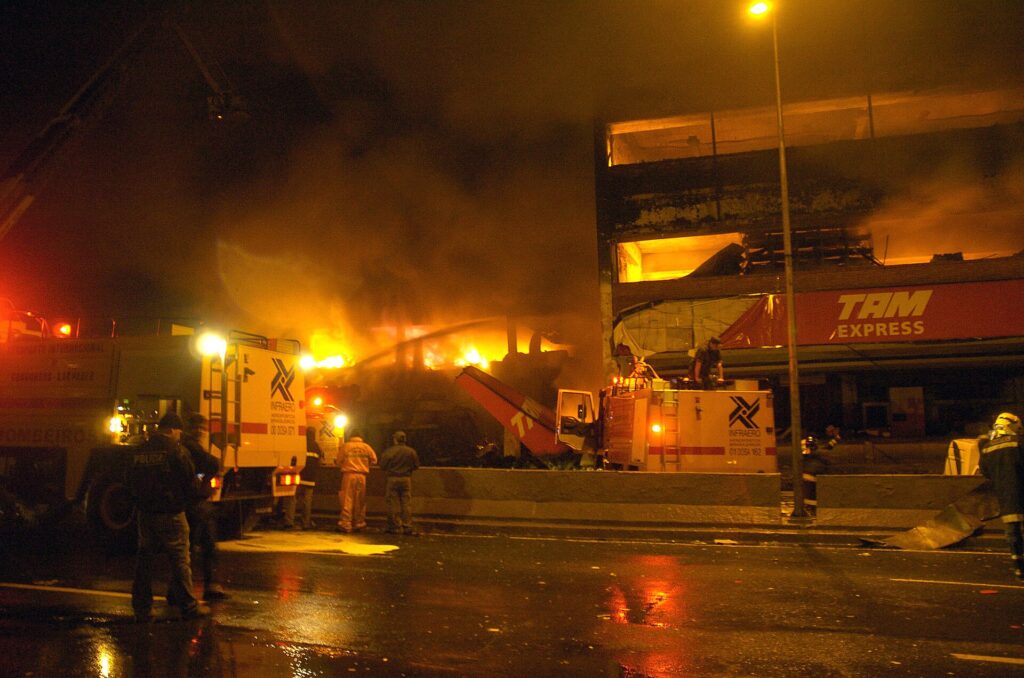
- It crosses Avenida Washington Luis, strikes the TAM cargo building and a petrol station
- All 199 on board and 12 on the ground die; the fires are severe
Congonhas Airport is located within the city of São Paulo — densely populated real estate surrounds the runway ends. An overrun at this airport has no margin for recovery. The accident destroyed the TAM cargo building and a petrol station; the death toll was almost certainly limited by the specific direction of the overrun.
Systems Engineering Perspective
From a systems engineering perspective, TAM 3054 is the multi-factor compounding case — the accident produced by the simultaneous presence of individually-tolerated conditions that together exceed system tolerance. The MEL permitted operation with a locked reverser. The runway was within published friction limits. The power lever position was a crew error. None of the three systems in place to manage each risk anticipated their simultaneous occurrence.
System tolerance is not the sum of individual component tolerances. A system with three independent marginal conditions may have zero residual tolerance when all three are present simultaneously. TAM 3054 is the proof.
The MEL — Permitting Operation With Reduced Margin
The Minimum Equipment List for the A320 permitted operation with a locked thrust reverser. This is a reasonable MEL provision — a single locked reverser does not prevent safe operation on most runways in normal conditions. The MEL provision exists with performance calculation requirements that account for the reduced stopping capability.
The performance calculation at Congonhas on a wet runway was marginally within limits with one reverser locked. There was no specific MEL restriction against operating into a short, wet runway with a locked reverser plus a degraded friction surface. The MEL addressed each condition independently. It did not address their combination.
MEL provisions that address individual equipment failures do not necessarily address the combined effect of multiple simultaneously-deferred items. The combination may create a total margin that no individual MEL provision anticipated.
The Power Lever Position — A Silent Error
The investigation found evidence that the left engine power lever was in the climb detent at touchdown — a position that commands approximately 70% of maximum thrust rather than the idle thrust required for landing. The result was active forward thrust on the left engine throughout the landing roll.
Whether this was an inadvertent selection, a throttle confusion error, or a result of the A320’s thrust lever design in the approach configuration has been debated. What is certain is that the left engine was delivering significant forward thrust precisely when the braking system needed every marginal unit of decelerating force.
An engine delivering forward thrust during a landing overrun event is not an edge case — it is the difference between stopping on the runway and impacting an urban infrastructure at 100 knots.
Degraded Runway Surface — Within Limits, Below Expectation
The groove-fill repair on Runway 35L had reduced the pavement friction coefficient from its published value. The repair had been assessed as within acceptable limits. The landing performance calculation used published friction data — data that did not reflect the post-repair actual friction at the approach end.
The aircraft was calculating its stopping distance against a friction value that was optimistic for the actual runway surface it was landing on.
Human Factors Perspective
The human factors analysis of TAM 3054 encompasses both the individual crew error (power lever position) and the organisational decisions (MEL approval, runway friction assessment) that created the environment in which that error was unrecoverable.
Throttle Confusion on Landing
The A320’s thrust lever design has the idle and climb positions adjacent to each other. Under the cognitive and physical demands of a short-runway, wet-runway approach with an MEL deferred item and active rain, the precision motor control required to ensure the correct lever position is subject to degradation. The error was small in mechanical terms. It was catastrophic in operational terms.
Adjacent lever positions on safety-critical controls, combined with high workload landing conditions, create the conditions for small positional errors with large consequences.
MEL Culture and Risk Normalisation
The operation of the A320 into Congonhas with a locked thrust reverser, in rain, on a short runway with a degraded surface, represents a risk that the MEL system permitted individually but that the combination exceeded. The normalisation of MEL deferred items as acceptable operational conditions can mask the compounding effect of multiple simultaneous deferrals.
System Interaction Breakdown
1. Three Simultaneous Marginal Conditions
Locked reverser (MEL), forward thrust on landing (power lever error), degraded runway friction (surface repair). Each within individual tolerance. Together, beyond total system tolerance.
2. Performance Calculation Using Published Rather Than Actual Friction
Stopping distance calculated on a friction value that overestimated actual surface conditions.
3. No Combined-Condition MEL Restriction
The MEL addressed the locked reverser in isolation. No provision addressed the combination with degraded runway friction.
Significance in Aviation Risk
1. Runway Closed and Repaired
Congonhas Runway 35L was closed and the groove-fill repair was removed. The runway was repaved.
2. MEL Restrictions for Combined Conditions
MEL provisions for thrust reverser inoperability were revised to include restrictions for operations into specific runway conditions — short runways, contaminated surfaces — where the combination of deferred item and runway condition creates insufficient combined margin.
3. Landing Performance Calculation Using Actual Friction Data
Requirements for landing performance calculations to use actual friction data, not published design values, were developed for contaminated runway conditions.
Related Aviation Risk Lab Content
Pillar Pages
Systems Engineering: Systems Engineering
Maintenance and Airworthiness: Maintenance And Airworthiness
Risk Assessment: Risk Assessment
Related Case Studies
Case Study 30: Lauda Air 004 — The Thrust Reverser at Cruise: Lauda Air 004
Case Study 19: Alaska Airlines 261 — The Jackscrew: Alaska 261
Case Study 50: American Airlines 1420 — Thunderstorms, Speed and the Decision: AA 1420
Closing Perspective
TAM 3054 is the definitive case study in compounding marginal conditions. The MEL was valid. The runway was within limits. The power lever error was small. The combination was fatal.
The lesson is systemic and extends beyond aviation: safety systems that address individual conditions independently may fail to protect against the combination of multiple simultaneous conditions that each fall within individual tolerance. This is the interaction problem in safety engineering — the gap between individual component risk assessment and system-level risk assessment.
The 211 people who died at Congonhas died because three marginal conditions compounded beyond the system’s total tolerance. The individual tolerances were real. The combined tolerance was not.
TAM 3054 is the proof that passing three independent safety checks does not guarantee passing a combined system check. Marginal conditions compound. System tolerance is not the sum of individual tolerances.