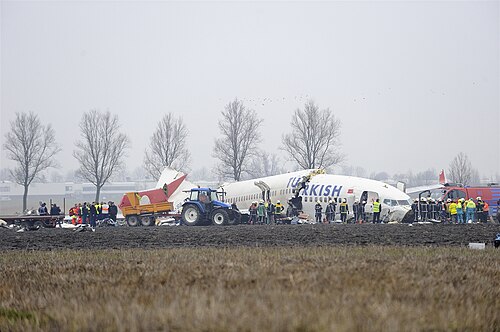
Turkish Airlines Flight 1951 demonstrated how small technical faults can rapidly propagate through tightly coupled aviation systems when automation assumptions are not fully understood by flight crews.
On 25 February 2009, the Boeing 737-800 crashed during approach to Amsterdam Schiphol Airport after the aircraft’s autothrottle system reduced engine thrust in response to a faulty radio altimeter reading. The aircraft stalled and impacted terrain short of the runway, killing nine people.
The accident highlighted the interaction between automation logic, crew monitoring, training, and degraded situational awareness within a highly automated cockpit environment.
Accident Overview
- Aircraft: Boeing 737-800
- Operator: Turkish Airlines
- Location: Amsterdam Schiphol Airport, Netherlands
- Date: 25 February 2009
- Fatalities: 9
- Primary Themes: Automation dependency, mode awareness, human-system interaction, failure propagation
The Initial Failure
During descent, the aircraft’s left radio altimeter began transmitting an erroneous reading indicating negative altitude values.
Although the fault itself was relatively minor, it triggered unintended automation behaviour within the aircraft’s autothrottle system.
The Boeing 737’s automation logic interpreted the false altitude indication as evidence that the aircraft had already landed, causing the autothrottle to retard thrust levers toward idle power during the approach.
This represented a classic example of:
👉 Failure Propagation Through System Coupling
A single sensor anomaly propagated into multiple interconnected systems because the aircraft’s automation architecture relied on shared data assumptions between components.
Automation Dependency and Mode Awareness
As engine thrust reduced, the aircraft gradually lost airspeed.
The flight crew failed to recognise the decreasing energy state until moments before stall activation.
The accident demonstrated how highly automated environments can reduce direct awareness of aircraft energy management when crews become reliant on automation behaviour remaining consistent and predictable.
This directly connects to:
👉 Human-System Interaction
and:
👉 Automation Dependency in Aviation
The crew were not simply “distracted.” Instead, the automation behaviour itself altered the operational context in subtle ways that delayed recognition of the developing hazard.
Situational Awareness Breakdown
The aircraft’s decaying airspeed was technically visible on cockpit instruments, yet the crew’s situational awareness deteriorated as attention became distributed across multiple tasks during approach.
This reflected a broader human factors issue involving:
- expectation bias
- automation trust
- monitoring degradation
- cognitive workload during high-tempo operations
These themes closely align with:
👉 Situational Awareness in Aviation
and:
👉 Decision-Making Under Stress
The crew’s mental model of the aircraft state no longer matched the aircraft’s actual energy condition.
Training and Organisational Factors
Investigators also identified weaknesses in training related to automation mode awareness and autothrottle behaviour.
The accident raised broader questions regarding:
- pilot understanding of automation logic
- training emphasis on degraded automation states
- recovery recognition during low-energy approaches
- assumptions regarding system reliability
This connects strongly to:
👉 Safety Culture in Aviation
and:
👉 Normalisation of Deviance
Over time, increasing trust in highly reliable automation systems can unintentionally reduce sensitivity to rare but hazardous automation anomalies.
A System-Level Perspective
Turkish Airlines Flight 1951 was not caused by a single equipment malfunction or a single human error.
The accident emerged from interactions between:
- faulty sensor inputs
- automation design assumptions
- cockpit monitoring limitations
- crew workload distribution
- training gaps
- delayed recognition of energy-state degradation
The event demonstrated how tightly coupled aviation systems can transform small technical anomalies into catastrophic operational outcomes when human operators are unable to effectively detect or interrupt failure propagation pathways.
Related Aviation Safety Topics
👉 Human Factors in Aviation
👉 Systems Engineering in Aviation
👉 Safety Engineering in Aviation
👉 Aviation Accident Case Studies