The Event
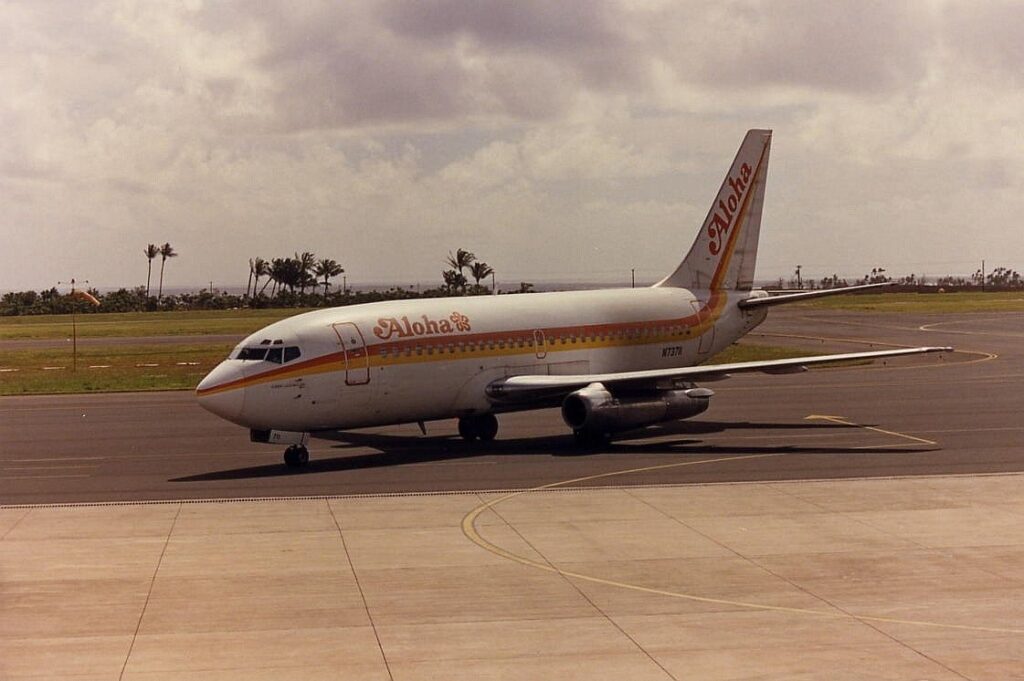
- Boeing 737-297 operates inter-island Hawaiian routes — up to 17 flight cycles per day
- Each flight cycle represents a full pressurisation and depressurisation of the fuselage
- By April 1988, the aircraft has accumulated 89,680 flight cycles — far beyond original design assumptions
- Moisture, salt air, and heat cycles accelerate adhesive disbonding in fuselage lap joints
- At 24,000 feet, a section of the upper fuselage approximately 18 feet long separates
- The cabin is exposed to the open sky; Clarabelle Lansing is swept out
- 65 passengers and crew are injured; Captain Robert Schornstimer and First Officer Madeline Tompkins retain control
- Emergency descent initiated; aircraft lands at Kahului Airport 13 minutes after structural failure
The structural failure covered an area from just aft of the forward door to the leading edge of the wing — one of the largest single structural failures ever survived in a commercial aircraft.
Systems Engineering Perspective
From a systems engineering perspective, Aloha 243 reveals the consequences of operating a mechanical system beyond the operational assumptions embedded in its structural design — in an environment that accelerates the primary failure mechanism — with an inspection programme calibrated for the original design assumptions rather than the actual operating conditions.
The 737’s structural life was calculated for a different aircraft, operating a different route structure, in a different environment. Aloha’s actual operation violated all three assumptions — and the maintenance programme never caught up.
Multi-Site Damage — The Failure Mode Inspection Could Not Find
The Boeing 737 fuselage skin was joined in overlapping panels, bonded with adhesive and fastened with rivets. In tropical Hawaiian conditions — high humidity, salt air, high thermal cycling, and extremely frequent pressurisation cycles — moisture infiltrated the lap joint adhesive and initiated corrosion at the rivet holes.
The resulting failure mode was multi-site damage (MSD): the simultaneous development of fatigue cracks at many adjacent rivet holes. Each individual crack was small — below the minimum detectable size for the visual inspection methods in use. Individually, none would have been flagged. Together, they formed a failure front spanning the full width of the lap joint.
The inspection programme had been designed to detect and assess individual cracks. It had no framework for assessing the cumulative structural effect of many sub-threshold cracks occurring simultaneously. The failure mode was real; the inspection architecture was invisible to it.
An inspection programme that is blind to the actual failure mode is not a safety barrier. It is an illusion of safety.
Cycles Not Hours — The Wrong Life-Limiting Parameter
The 737’s structural life limit was expressed in flight hours as well as cycles — but the maintenance planning at Aloha had not adjusted inspection intervals to reflect that inter-island operations accumulated cycles at a rate far exceeding the original design assumptions. An aircraft completing 17 short flights per day accumulates a pressurisation cycle for every flight. An aircraft on a normal transcontinental route might complete four.
The 737 in question had accumulated cycles at roughly four times the rate assumed in the original fatigue analysis. Its structural age, measured in damage accumulation, was dramatically greater than its calendar age or flight-hour total suggested.
Structural life management must be based on the actual damage parameter — cycles, not hours, not calendar time. Aloha 243 established that these are not interchangeable.
Normalisation of Corrosion — The Culture of Tolerance
Aloha Airlines’ maintenance culture had developed a tolerance for corrosion findings. Inspectors regularly found corrosion in the lap joints and surrounding structure — and treated it as a routine maintenance finding that was documented, assessed at a minimal level, and deferred. The cumulative effect of these deferred findings was never assessed at the systemic level.
This is normalisation of deviation: the progressive acceptance of an out-of-tolerance condition as normal because it has been seen before and nothing catastrophic has happened yet. The safety boundary moves incrementally, invisibly, until it has moved far enough to enable a catastrophe.
Human Factors Perspective
The human factors dimension of Aloha 243 is primarily a maintenance culture and organisational oversight story. The crew’s extraordinary performance in recovering the aircraft is a secondary human factors case study in itself — but the systemic failure that created the situation was entirely in the maintenance and regulatory system that surrounded the aircraft.
Inspection Culture — Seeing but Not Seeing
Aloha maintenance staff had documented corrosion findings on many previous inspections of this aircraft. The findings had been assessed and closed as within acceptable limits. No inspector had aggregated the findings, plotted their distribution, or assessed the cumulative structural implication of widespread corrosion across the fuselage skin.
This is the difference between item-level inspection and systemic structural assessment. Item-level inspection asks ‘is this crack too big?’ Systemic structural assessment asks ‘what does the pattern of findings across this aircraft tell us about its structural condition?’ Aloha’s programme was doing the former and not the latter.
Inspection that assesses individual findings without assessing patterns cannot detect failure modes that are distributed rather than localised.
Crew Performance Under Catastrophic Structural Failure
The crew of Aloha 243 faced a scenario with no training, no checklist, and no precedent. The aircraft had lost a significant section of its structure, creating enormous aerodynamic drag. The noise and buffeting were extreme. Passengers and crew in the cabin were exposed to wind and debris.
Captain Schornstimer and First Officer Tompkins declared an emergency, initiated an immediate descent, and flew the aircraft to a landing in conditions no test pilot had certified it to survive. Their performance reflects the quality of training, the depth of type knowledge, and the ability to maintain controlled action under maximum stress.
System Interaction Breakdown
1. Operating Beyond Design Assumptions
The aircraft operated at cycle rates, in an environmental corrosion regime, and to a total cycle accumulation that were all beyond the design assumptions embedded in its structural fatigue analysis. The design worked for the aircraft it was designed for. It failed for the aircraft Aloha actually operated.
Every structural life limit embeds a set of operational assumptions. When operations deviate from those assumptions, the life limit is no longer valid.
2. Inspection Calibrated for Wrong Failure Mode
Visual inspection is effective for cracks that have grown to visible size in isolation. It is not effective for multi-site damage, where many cracks remain individually sub-threshold while collectively constituting a failure front. The mismatch between the inspection method and the actual failure mode was the central technical failure.
3. No Systemic Corrosion Assessment
Individual corrosion findings were assessed and closed. No systemic assessment of the corrosion distribution pattern was conducted. The pattern — widespread, correlated with the lap joint structure, accelerating — was visible in the maintenance records. It was not visible to any individual inspector assessing any individual finding.
Safety data that exists but is not aggregated and analysed is not safety intelligence — it is an untapped warning system.
Significance in Aviation Risk
1. Multi-Site Damage Recognised as a Distinct Failure Mode
MSD was identified, defined, and incorporated into structural certification and inspection requirements as a result of Aloha 243. Aircraft structural assessments now explicitly address MSD susceptibility and include inspection methods — such as eddy current testing — capable of detecting sub-threshold cracks in aggregate.
2. Ageing Aircraft Programme
The FAA’s Ageing Aircraft programme was directly driven by Aloha 243. It established supplemental inspection requirements for high-cycle aircraft, mandated structural lap joint inspections, and created a framework for managing aircraft operating well beyond original design cycle assumptions.
3. Lap Joint Inspection Standards
Lap joint inspection requirements were completely overhauled. Visual inspection was replaced with mandated eddy current testing for all high-cycle 737s. The detection capability was transformed from ‘visible cracks in isolation’ to ‘sub-threshold crack arrays in lap joint structure.’
Related Aviation Risk Lab Content
Pillar Pages
Maintenance and Airworthiness: Maintenance And Airworthiness
Systems Engineering: Systems Engineering
Design and Certification: Design And Certification
Related Case Studies
Case Study 8: de Havilland Comet — Pressurisation and the Crack That Remade Aviation: Comet 1954
Case Study 39: China Airlines 611 — The Repair That Held for Twenty-Two Years: China Airlines 611
Case Study 45: Chalk’s Ocean Airways — The Wing That Should Have Been Retired: Chalks Ocean
Closing Perspective
Aloha 243 is the case study that broke the assumption that a maintained aircraft is a safe aircraft. The aircraft had been inspected to the programme. The programme could not see what it needed to see. The inspectors were not negligent — they were operating in a system that had no tools for the failure mode they were facing.
The structural life of every commercial aircraft now incorporates explicit MSD assessment, environmental factor adjustments, and eddy current inspection requirements for lap joints. These requirements exist because of what happened over Maui on 28 April 1988.
The ageing aircraft problem will not go away. Every aircraft in service accumulates damage cycle by cycle, landing by landing, pressurisation by pressurisation. The obligation is to understand what that damage looks like, to design inspections that can detect it, and to replace life-limited structure before it fails.
Aloha 243 is the reason ageing aircraft have supplemental inspection programmes. The accident proved that original inspection requirements, designed for original operational assumptions, are insufficient for aircraft that have exceeded those assumptions.