The Event
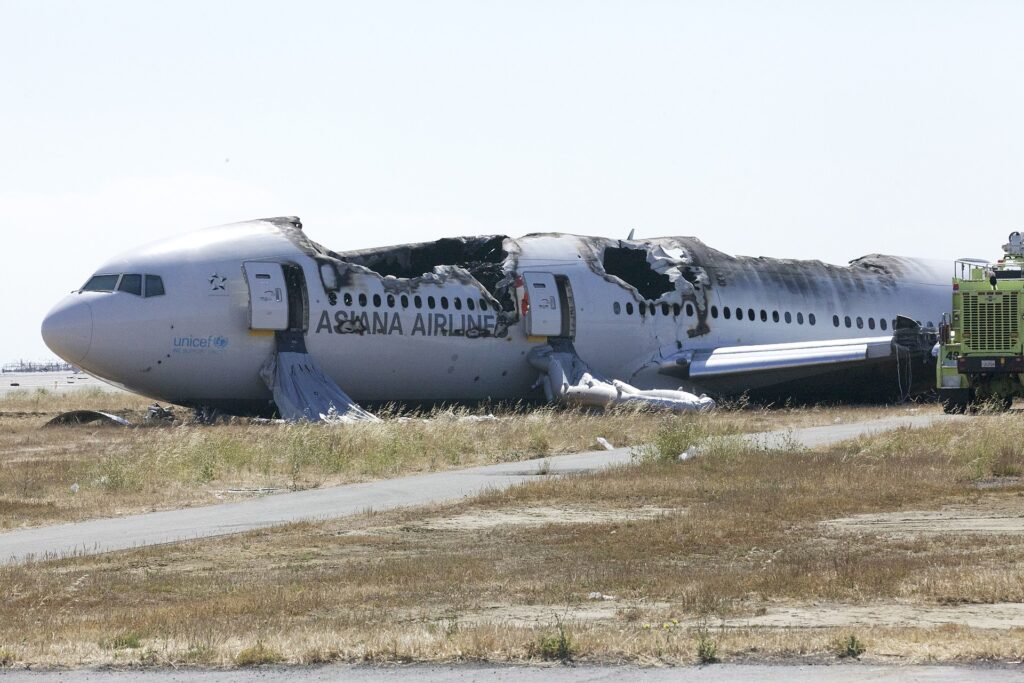
- Asiana 214 establishes on a visual approach to SFO Runway 28L — the ILS glideslope is out of service
- The crew selects autothrottle in FLCH (Flight Level Change) mode — which does not maintain airspeed during descent
- Unknown to the crew, the autothrottle is in a configuration that will allow airspeed to decay on approach
- Speed decays progressively below target approach speed
- At 500 feet, the stick shaker activates — stall warning
- A go-around is initiated but at too low an altitude to prevent impact
- The aircraft strikes the seawall 320 feet short of the runway threshold at 116 knots
- The tail section is torn off; the aircraft slides down the runway; 3 passengers die
The captain flying had 43 flight hours on the Boeing 777, was on his first trip as PIC on type, and had been paired with an instructor who had not completed his own qualification for this approach type. The qualification system had placed an under-qualified crew in a training scenario.
Systems Engineering Perspective
From a systems engineering perspective, Asiana 214 exposes the autothrottle mode interaction problem — a class of automation behaviour where the interaction between two correctly-functioning autoflight modes produces an unintended and hazardous outcome that requires specific system knowledge to anticipate and monitor.
Two autoflight systems, each functioning correctly in their own mode, can interact to produce a result that neither was designed to create. Understanding those interactions requires specific training — not just understanding of each system in isolation.
FLCH Mode and Speed Management
The Boeing 777’s Flight Level Change mode commands the autopilot to achieve a target altitude using pitch, while the autothrottle manages thrust to maintain a target speed — but only in the climb direction. In descent, FLCH commands pitch to achieve the target altitude while the autothrottle follows the thrust required by the pitch attitude, which may be idle.
On a stabilised descent approach, with the aircraft in a nose-up attitude to maintain the visual glidepath, FLCH with certain conditions effectively commands idle thrust — allowing airspeed to decay. This behaviour is correct for what the mode is designed to do. It is hazardous on a final approach where airspeed must be maintained above stall speed.
A mode that functions correctly in its design context can produce a hazardous outcome in a different operational context. Mode awareness requires understanding the design context of each mode and its behaviour outside that context.
Glideslope Inoperative — Increased Manual Load
The ILS glideslope was out of service. The crew was conducting a visual approach without electronic vertical guidance. In this configuration, monitoring the visual glidepath, the autoflight configuration, and the airspeed simultaneously required a level of attention and workload management that the crew’s limited experience on this approach type did not adequately support.
Human Factors Perspective
The human factors analysis centres on automation mode confusion — the mismatch between the crew’s mental model of what the automation is doing and what it is actually doing — and on the insufficient type-specific training that left the crew unprepared for this specific mode interaction.
Mode Confusion — The Gap Between Mental Model and Reality
The crew believed the autothrottle was maintaining approach speed. It was not. This gap between the crew’s mental model of the autoflight state and its actual state is mode confusion — one of the most frequently identified human factors in automation-related accidents. Mode confusion is not carelessness. It is the predictable result of complex automation with insufficiently trained mode interaction behaviour.
Mode confusion is not a pilot error. It is the result of a training system that has not adequately prepared crews for the automation interactions they will encounter in operation.
Insufficient PIC Experience on Type
The captain had 43 flight hours on the 777. He was on his first revenue trip as PIC on type. His instructor had not completed his own qualification for a visual approach of this type without glideslope. The system had placed an under-qualified crew pair in a scenario that exposed the limits of their qualifications.
This is not a failure of individual competence — it is a failure of the qualification system to ensure that the combination of crew qualifications matched the demands of the operation.
System Interaction Breakdown
1. Autothrottle Mode Allowing Airspeed Decay
The FLCH mode interaction allowed airspeed to decay on approach without an alert that was prominent enough to attract the crew’s attention in the operational context.
2. Inadequate Speed Monitoring
No crew member was making explicit, regular speed callouts — a PNF monitoring duty that would have detected the decay significantly earlier.
Significance in Aviation Risk
1. Automation Mode Awareness in Type Training
Post-Asiana 214, automation mode interaction training was elevated as a specific, required element of 777 type rating and recurrent training — including FLCH mode behaviour in approach configurations.
2. Speed Monitoring as PNF Duty
Speed callouts at specified intervals during the approach were formally incorporated into SOPs as an explicit, mandatory PNF duty.
3. PIC Qualification for Specific Approach Types
Qualification verification for specific approach types — including visual approaches without glideslope — was elevated as a scheduling requirement.
Related Aviation Risk Lab Content
Pillar Pages
Automation and Technology: Automation And Technology
Human Factors: Human Factors
Crew Resource Management: Crew Resource Management
Related Case Studies
Case Study 20: Air France 447 — When the Automation Stopped: Af 447
Case Study 23: Turkish Airlines 1951 — The Altimeter That Fooled the Throttle: Turkish 1951
Case Study 11: Korean Air 801 — CFIT, Authority Gradient: Korean Air 801
Closing Perspective
Asiana 214 happened in clear skies with a functioning aircraft because a crew did not understand what the automation was doing — and because the training system had not ensured they would. The FLCH mode interaction that allowed airspeed to decay on approach is a specific, teachable piece of system knowledge. It was not taught adequately.
The three deaths, 182 injuries, and destruction of a $175 million aircraft are the price of a training curriculum gap. The automation mode awareness training that now exists in 777 type ratings addresses that specific gap.
Asiana 214 is the case that proved that understanding automation is not optional for the pilots who operate it. Not understanding the automation killed people. Understanding it would have kept them alive.