The Event
- KAL 801 departs Seoul for Guam on a scheduled night service
- The ILS glideslope for Guam’s Runway 06L is out of service — noted in NOTAMs
- The crew does not adequately brief the implications of the glideslope outage for the approach procedure
- The captain elects to conduct a VOR/DME non-precision approach, which requires strict compliance with step-down altitudes
- The captain descends below the minimum safe altitude prior to reaching the step-down fix
- The first officer and flight engineer possess information suggesting the approach is unstable
- Neither crew member assertively challenges the captain’s approach profile
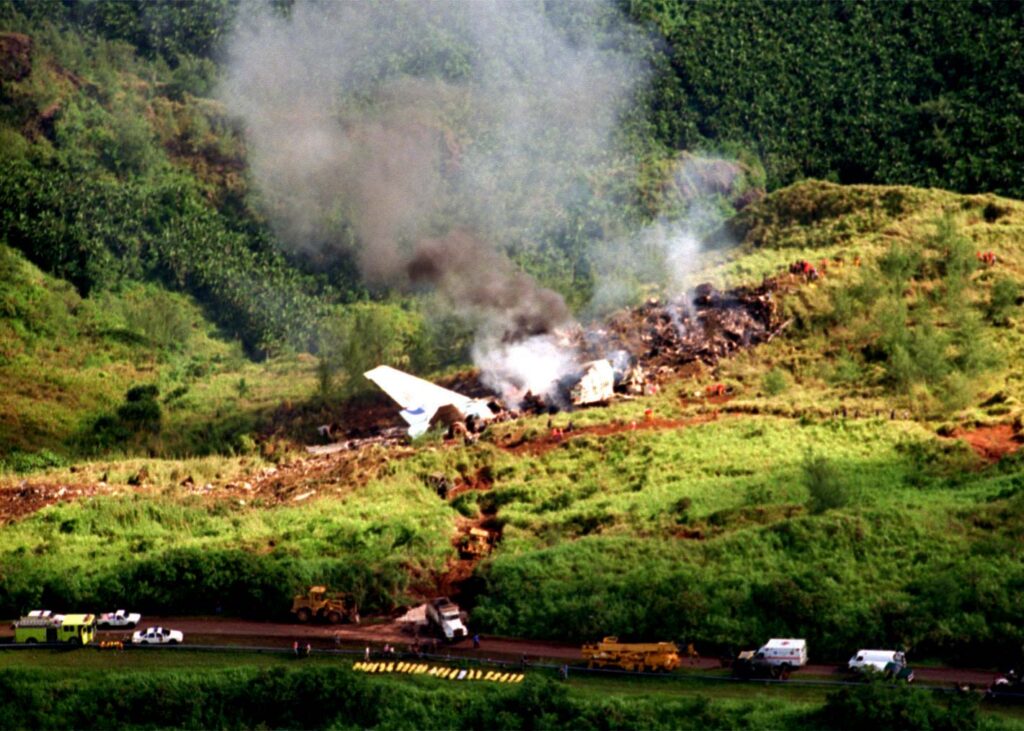
- At 01:42, the aircraft strikes Nimitz Hill at 660 feet AMSL, 3.6 nm from the runway
- 228 of 254 on board die; 26 survive in a field of wreckage
Korean Air’s fatal accident rate in the period 1970-1999 was among the highest of any major international carrier. This accident, along with several others, triggered a complete restructuring of Korean Air’s flight operations culture.
Systems Engineering Perspective
From a systems engineering perspective, KAL 801 presents a failure in both the procedural and technological layers of the approach safety system. The non-precision approach procedure had adequate safety margins — if the step-down altitudes were complied with. The compliance mechanism was entirely dependent on crew adherence, with no technological backstop. And the technology that would have provided a backstop — EGPWS with a terrain database — was not installed.
A procedure with adequate safety margins, combined with no technical enforcement of those margins, is a system whose safety depends entirely on the crew executing the procedure correctly every time. That is not a safety system — it is a hope.
Non-Precision Approach Design — Procedure Without Technical Backstop
The VOR/DME approach to Guam with the glideslope inoperative is a non-precision approach — it provides lateral guidance but no vertical path guidance. Safety is maintained by the pilot complying with step-down altitude minima at defined distance-from-threshold fixes. These minima are calculated to provide terrain clearance at each stage of the descent.
When the captain descended below the step-down minimum prior to reaching the relevant fix, the terrain clearance margin was violated. The approach procedure had no technical means to prevent this. There was no electronic glidepath to fall below. There was no altitude alerting system calibrated to the non-precision minima. The only barrier was the crew executing the procedure correctly — a single-layer defence.
Non-precision approaches place the entire burden of vertical path compliance on the crew, with no technical assistance and no automated backup. They are the highest-risk approach type for terrain proximity.
NOTAM Assimilation — Information That Didn’t Reach Decision-Making
The glideslope outage was published in the NOTAM system — the correct and appropriate publication mechanism. The crew had access to this information and had received a pre-departure weather and NOTAM briefing. However, the implications of the glideslope outage — that the approach type changed, and that the non-precision procedure had significantly different altitude management requirements — were not adequately briefed or assimilated by the crew.
Information that exists in the system but is not internalised by the operational decision-makers is, at the moment of decision, equivalent to information that does not exist.
NOTAM information that reaches the flight plan but not the crew’s operational awareness has not reached the system boundary where it can prevent accidents.
EGPWS — The System That Wasn’t There
Enhanced Ground Proximity Warning Systems, using terrain databases to provide look-ahead terrain alerts, had been developed and were available for installation. They were not yet mandatory and were not fitted to this aircraft. The basic GPWS fitted to the aircraft generated a warning — but less than 12 seconds before impact. Insufficient time for recovery.
EGPWS, with its terrain database, would have generated a warning 60 seconds or more before impact — sufficient time for the crew to initiate a go-around and clear the terrain. The technology that would have saved 228 lives existed. It simply was not on the aircraft.
Human Factors Perspective
The human factors dimension of KAL 801 is one of the most thoroughly studied examples of cultural authority gradient as a flight safety system failure. The academic and investigative work that followed this accident fundamentally changed the industry’s understanding of how cultural values — specific to a society — can create systematic vulnerabilities in aviation crews drawn from that society.
Power Distance and the Korean Air Cockpit
Cultural psychologist Geert Hofstede’s measure of power distance — the degree to which members of a society accept and expect unequal distribution of power — placed South Korea among the highest-scoring nations in the world in the 1990s. In practical terms, this meant that challenging a superior’s decision was not merely professionally risky; it was culturally inappropriate at a fundamental level.
Korean language itself embeds hierarchy. The verbal forms used to address a superior are structurally different from those used with peers. The first officer, speaking to a captain in Korean, was using a form of address that encoded deference before any operational content was conveyed.
Language that embeds hierarchy is a cockpit design factor. When the first officer cannot say ‘you are wrong’ without also saying ‘I defer to you,’ the communication system itself works against safety.
The Transformation of Korean Air
Following KAL 801 and several other accidents in the same period, Korean Air made a decision with few parallels in aviation history: it brought in external safety consultant David Greenberg and committed to a complete cultural transformation of its flight operations.
English was mandated as the in-cockpit language for all operations — partly to neutralise the hierarchy embedded in Korean verbal forms. CRM was redesigned around Korean cultural specifics rather than the Anglo-American frameworks it was built on. Recruitment, training, and evaluation standards were rebuilt. Korean Air has not had a fatal accident since 1999.
Korean Air’s transformation proved that institutional safety culture can be rebuilt — that accidents driven by cultural factors are not inevitable consequences of national heritage, but solvable problems requiring cultural-specific solutions.
First Officer’s Role as Terrain Monitor
The post-KAL 801 emphasis on the Pilot Monitoring role as an active, empowered, assertive terrain and altitude monitor — not merely a system checker — emerged directly from this accident. The first officer’s passive awareness of the terrain proximity was insufficient. What the system required was an assertive, trained, procedurally-mandated intervention: ‘Captain, we are below the step-down altitude. Go around now.’
System Interaction Breakdown
1. Non-Precision Approach With No Vertical Guidance
The removal of the ILS glideslope changed the approach type to one with no technical vertical path guidance and no automated monitoring. The crew’s ability to maintain terrain clearance depended entirely on manual altitude management at step-down fixes. No technical system provided independent monitoring.
When the glideslope is inoperative, the safety system loses its vertical guidance layer. The remaining layers — crew procedure and GPWS — must function without support.
2. Cultural Authority Gradient Suppressing Safety Input
The crew possessed information suggesting the approach was unsafe. Cultural authority gradient prevented that information from reaching the person with the authority to act on it. The knowledge existed in the crew system; the system had no channel through which it could become action.
3. Technology Available But Not Installed
EGPWS was available. It was not mandatory. It was not installed. The accident occurred because a technology gap at the regulatory and operator level — not a technological failure — left the crew without the safety backstop that would have saved them.
When the technology exists to prevent a class of accidents and is not mandated, every accident in that class is a preventable accident.
Significance in Aviation Risk
1. EGPWS Mandated Globally
EGPWS with terrain database was mandated for all large commercial transport aircraft following KAL 801, producing one of the most dramatic reductions in controlled flight into terrain accidents in aviation history.
2. Cultural CRM Training Developed
The post-KAL 801 period produced the first generation of CRM training programmes specifically designed for cultural contexts outside the Anglo-American framework in which CRM was originally developed.
3. Korean Air as a Model for Cultural Transformation
Korean Air’s complete safety culture transformation, from one of the world’s most dangerous to one of the world’s safest major carriers, has become the benchmark case study for how institutional safety culture can be rebuilt.
4. Non-Precision Approach Briefing Standards
Post-KAL 801, the explicit briefing requirement for glideslope inoperability — including the change in approach type, minimum altitudes, and step-down compliance requirements — was standardised across commercial operations.
Related Aviation Risk Lab Content
Pillar Pages
Human Factors: Human Factors
Crew Resource Management: Crew Resource Management
ATC and Communications: Atc And Communications
Related Case Studies
Case Study 3: United 173 — The Hierarchy of Silence: United 173
Case Study 1: Tenerife — When a System Has No More Margins Left: Tenerife 1977
Case Study 51: Crossair 3597 — CFIT in the Night: Crossair 3597
Closing Perspective
Korean Air 801 is the case study that proved that authority gradient is not a personality problem — it is a system design problem. The first officer’s failure to prevent the accident was not a failure of individual courage. It was the predictable output of a crew system embedded in a cultural context that made direct challenge of a superior effectively impossible.
The mandating of EGPWS, the development of culturally-specific CRM, and the transformation of Korean Air’s flight operations are the systemic responses to this accident. Together, they demonstrate that the industry can identify the root cause of a cultural failure and actually fix it — not by changing human nature, but by redesigning the systems in which humans operate.
The terrain database in every EGPWS system flying today was motivated, at least in part, by what happened on Nimitz Hill in August 1997. For the passengers of every flight that EGPWS has warned off terrain since, that is a significant debt.
KAL 801 established that culture is not fate — it is a system input that can be identified, addressed, and changed. Korean Air’s transformation is the evidence.