The Event
- Bomb at Las Palmas diverts 30+ aircraft to Los Rodeos Airport, Tenerife
- Airport’s single runway used as a holding taxiway — aircraft nose-to-tail on the active surface
- Fog reduces visibility to approximately 300 metres — no ground surveillance radar available
- Both KLM 4805 and Pan Am 1736 hold for hours; crews are fatigued and under commercial pressure
- Gran Canaria Airport reopens; aircraft begin departing sequentially using the only runway
- KLM captain initiates takeoff roll without receiving ATC takeoff clearance
- Pan Am 1736 is still occupying the active runway, unable to locate the correct taxiway exit in fog
- Simultaneous radio transmissions produce a heterodyne squeal that masks Pan Am’s warning
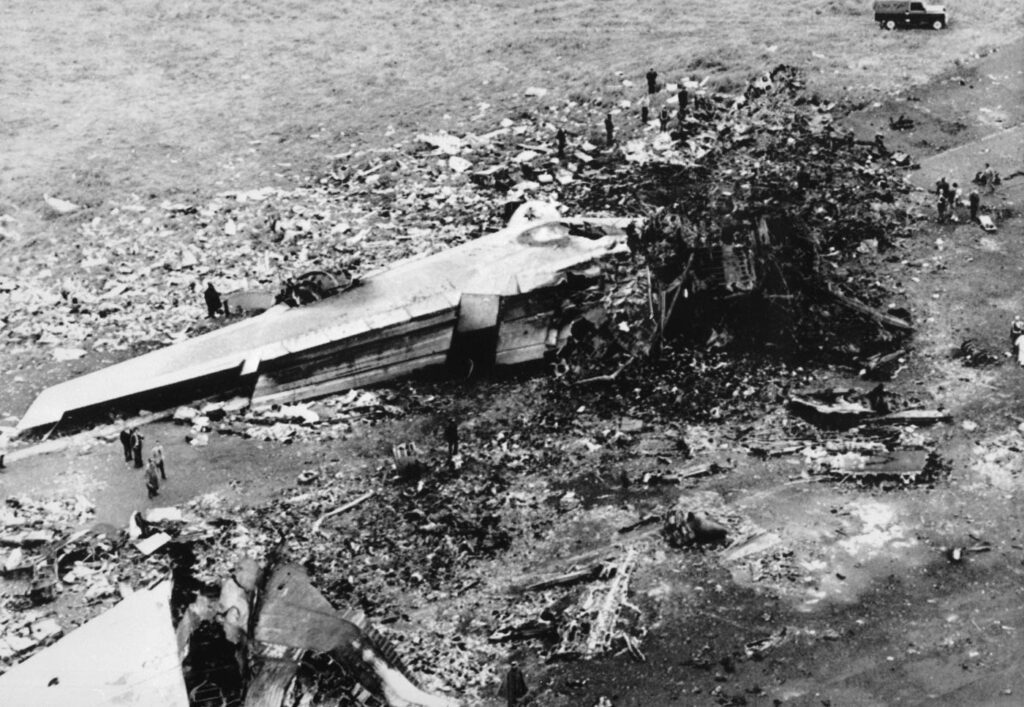
- KLM 4805 strikes Pan Am 1736 at approximately 140 knots — 583 people are killed
61 survivors were all aboard the Pan Am aircraft. There were no survivors from KLM 4805.
Systems Engineering Perspective
From a systems engineering perspective, Tenerife represents the convergence of independent system failures across every level of the aviation safety architecture — infrastructure, communications, surveillance, procedure, and crew coordination — occurring simultaneously under conditions of degraded environmental visibility.
Each individual failure was, in isolation, a known risk that the system had tolerated for years. The danger at Tenerife was not any one failure. It was the simultaneous activation of every latent weakness in the system at the same moment, in the same place.
System failure at Tenerife was not a cascade — it was a convergence. Every layer failed together.
Infrastructure Incapacity Under Surge Conditions
Los Rodeos Airport was a Category 1 domestic facility. Its single runway served as both the operating surface and the taxi route for aircraft holding — a design that was viable under normal low-volume operations. When 30+ diverted widebody jets arrived simultaneously, this single-runway architecture offered no physical separation between aircraft taxiing and aircraft in position for departure.
There was no ground movement radar. There were no stop bars on the runway. There was no secondary communication channel for runway occupancy. The airport’s physical design had no redundancy and no ability to accommodate this operational load. The system had no structural reserve.
The airport was not equipped for the operational scenario it was asked to support. This is an infrastructure failure that precedes every other failure in the chain.
Communication System Ambiguity
A single shared VHF frequency served all ATC-aircraft communications. The phrase used by KLM Captain van Zanten — ‘We are now at takeoff’ — was transmitted in a non-standard form that ATC interpreted as a position report. It was, in fact, the captain’s announcement of imminent departure.
ICAO had not yet mandated the phrase ‘cleared for takeoff’ as the only acceptable departure clearance. Regional variation in phraseology was accepted practice. This ambiguity had existed in the system for years. At Tenerife, it killed.
When Pan Am’s crew transmitted their warning — ‘We’re still on the runway!’ — a simultaneous ATC transmission caused heterodyne interference on the KLM receiver. The physics of single-frequency radio communication made this collision geometrically inevitable from the moment both transmissions began.
The communication system had no technical means to prevent simultaneous transmissions, no disambiguation protocol, and no read-back standard for departure initiation.
Surveillance Gap
In 1977, ground movement radar was not standard at airports of this size. Controllers had no real-time picture of aircraft positions on the manoeuvring area. Their situational awareness was based on verbal position reports — the same verbal reports that the fog and the radio ambiguity had made unreliable.
A system that could have detected the runway conflict before it became lethal did not exist. This was a known technology gap. It was not a novel risk.
Human Factors Perspective
The human factors dimension of Tenerife operates at two levels: the authority gradient within the KLM flight deck, and the broader cultural norm that made challenging a senior captain functionally impossible in 1977.
Authority Gradient and the Suppression of Safety-Critical Input
Captain Jacob van Zanten was one of KLM’s most senior and publicly recognised pilots — his photograph appeared in airline advertising campaigns. He was also the head of KLM’s flight training programme. In every institutional dimension, he was the highest authority in the cockpit.
The flight engineer asked directly: ‘Is he not still on the runway, that Pan Am?’ This was a correct, safety-critical question. The captain’s response — dismissal and increased thrust — reflects not negligence but the product of a system in which junior crew members did not possess the culturally-sanctioned authority to override a senior captain’s decision. The flight engineer’s knowledge was right. The system gave him no effective mechanism to act on it.
The flight engineer had the information that would have prevented the accident. The system gave him no mechanism to use it.
Decision-Making Under Commercial and Schedule Pressure
KLM 4805 had been on the ground for over three hours. Crew duty time limitations were approaching. The commercial cost of further delay was real and immediate. The captain was operating under a combination of time pressure, fatigue, and the institutional weight of his own seniority. These factors narrowed his decision window and made any choice other than immediate departure feel professionally indefensible.
This is the psychology of plan continuation bias — the commitment to a course of action that persists even when new information should prompt a reassessment.
Commercial pressure and fatigue do not cause accidents directly. They narrow the decision space until the safe option becomes invisible.
The Birth of CRM
Tenerife was the direct catalyst for the development of Crew Resource Management as a formal discipline. The NASA workshop in 1979 that produced the first CRM framework specifically cited Tenerife as the definitive demonstration that flight deck authority gradients were a systemic safety risk.
The principle that junior crew members not only have the right but the professional obligation to assert safety concerns against a senior captain — and to escalate, repeat, and if necessary physically intervene — was formalised as a direct response to what happened in that cockpit.
System Interaction Breakdown
1. Single Point of Truth — One Frequency, No Redundancy
The entire communication system between all aircraft and ATC depended on a single VHF frequency with no fallback. A simultaneous transmission had a physical probability of occurring given the number of parties using the channel. The system had no technical response to this event.
One frequency serving all parties is not a communication system — it is a communication bottleneck with no safety margin.
2. Procedural Ambiguity Tolerated for Years
Non-standard departure phraseology had been in use across multiple ATC regions for decades. No mandatory read-back of takeoff clearance existed. The system had functioned with this ambiguity because no convergence event had previously occurred to expose it. Tenerife was the convergence event.
3. Infrastructure Design Assumption Mismatch
Los Rodeos was designed for a traffic volume and aircraft type that bore no resemblance to the event that unfolded. The physical airport — its runway, its taxiways, its communication systems — was incapable of safely managing the scenario it was asked to manage. No amount of crew skill or ATC professionalism could compensate for a physical infrastructure incapable of supporting the operation.
When infrastructure is the constraint, procedural fixes are insufficient. Tenerife demonstrated that system capacity must match operational demand.
Significance in Aviation Risk
1. Standard Phraseology Saves Lives
The post-Tenerife mandating of ‘cleared for takeoff’ as the sole acceptable departure instruction, and the mandatory read-back of all clearances, is directly attributed to this accident. The standardisation of ICAO phraseology is one of the most impactful regulatory changes in aviation history.
2. CRM Is a System Safety Requirement, Not a Soft Skill
The transformation of crew dynamics from hierarchy-based to coordination-based — formalised as CRM — began at Tenerife. It is the single most important organisational behaviour change in commercial aviation safety.
3. Ground Surveillance Is Non-Negotiable
The progressive mandating of ground movement radar at airports handling scheduled jet operations was accelerated by Tenerife. Surveillance on the ground is as safety-critical as surveillance in the air.
4. System Resilience Requires Physical and Procedural Redundancy at Every Level
Tenerife demonstrated that a system relying on a single runway, a single frequency, and a single source of authority has no resilience. Safety architecture must have depth — multiple independent layers, each capable of preventing an accident independently.
Related Aviation Risk Lab Content
Pillar Pages
Human Factors: Human Factors
Systems Engineering: Systems Engineering
Safety Engineering: Safety Engineering
ATC and Communications: Atc And Communications
Related Case Studies
Case Study 2: Eastern Air Lines 401 — The Altitude No One Owned: Eastern 401
Case Study 3: United 173 — The Hierarchy of Silence: United 173
Case Study 35: PSA 182 — The Mid-Air No Radar Could Prevent: PSA 182
Closing Perspective
Tenerife did not happen because one man made one mistake. It happened because the system had been designed with insufficient depth — insufficient infrastructure capacity, insufficient communication redundancy, insufficient surveillance capability, and insufficient cultural authority for junior crew members to override a catastrophically wrong decision.
Every safety reform that followed — standard phraseology, CRM, ground radar, read-back requirements — addressed a specific layer that had failed. Together, they represent the most comprehensive redesign of the aviation safety system’s foundational architecture that has ever occurred in response to a single event.
The lesson of Tenerife is not about one captain’s judgment. It is about the obligation of every aviation system designer, regulator, and operator to ensure that no single failure — and no single convergence of failures — can reach the outcome. That obligation has never changed.
Tenerife is not a cautionary tale about individuals. It is a systems engineering case study about what happens when defence-in-depth is absent.