Some accidents are caused by failures.
Others are caused by something more subtle:
uncertainty that is recognised… but not fully acted on.
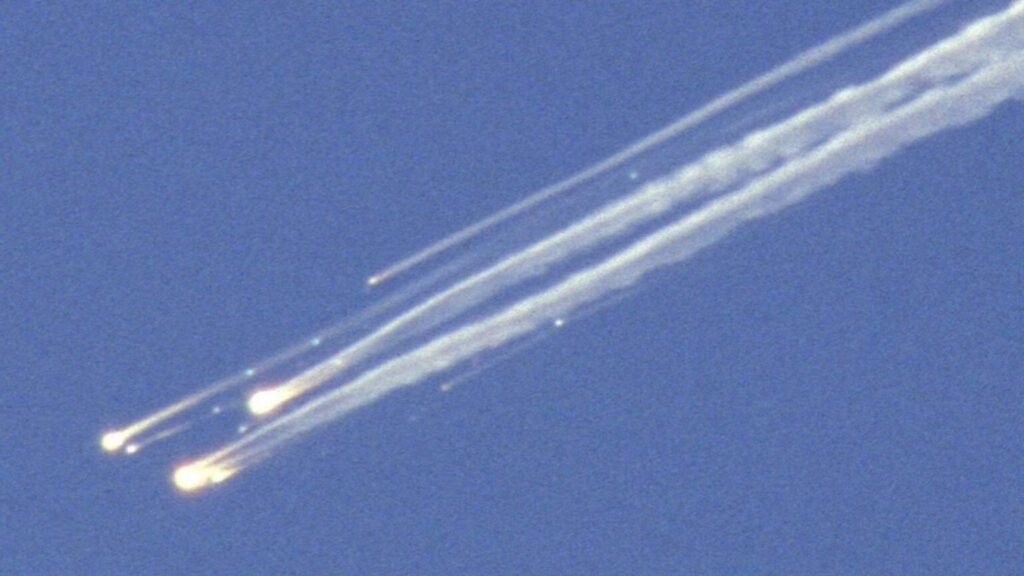
The loss of the Space Shuttle Columbia in 2003 is one of the clearest examples of this.
Not because engineers didn’t see the problem.
But because the system didn’t quite know what to do with what it was seeing.
It started with something that didn’t look critical
During launch, a piece of foam insulation broke off from the external tank and struck the left wing.
This wasn’t new.
Foam shedding had happened before:
- it was known
- it was documented
- it had been analysed
- and previous flights had survived similar events
So the initial reaction was not panic.
It was something more familiar:
“we’ve seen this before”
The problem wasn’t the strike—it was what it might have done
Very early on, engineers started asking the right question:
what if this time was different?
Because the concern wasn’t the foam itself.
It was:
- whether it had damaged the reinforced carbon-carbon (RCC) panels
- whether that damage could survive re-entry
- and whether there was any way to verify the condition of the wing
And this is where uncertainty enters the system properly.
Not as ignorance—but as incomplete knowledge with potentially severe consequences.
Requests for more data… that didn’t quite land
Some engineers pushed for:
- high-resolution imaging from military or ground-based assets
- better analysis of the impact scenario
- more definitive assessment of wing integrity
But these requests didn’t fully convert into action.
Not because they were dismissed outright.
But because of something more subtle:
- assumptions about survivability
- belief in existing analysis
- and uncertainty about what could realistically be done even if damage was confirmed
So the system started to stabilise around a position:
the situation is uncertain, but likely acceptable.
This is where uncertainty becomes dangerous
There’s a specific point in complex systems where uncertainty stops being a trigger for action…
…and starts becoming something to manage.
That shift is critical.
Because once uncertainty is framed as:
- low likelihood
- previously encountered
- or operationally non-actionable
…it stops driving escalation.
And starts being absorbed into normal operations.
The uncomfortable question: what would you have done?
This is where the case becomes genuinely interesting from a safety engineering perspective.
Because it’s easy to say, in hindsight:
- more data should have been gathered
- the risk should have been escalated
- alternative options should have been explored
But at the time:
- there was no clear repair capability
- no established rescue plan
- and no guaranteed way to change the outcome
So the system was operating under a quiet constraint:
even if the worst case is true… what is the actionable path?
And that question shaped behaviour more than the uncertainty itself.
When lack of options shapes interpretation
One of the more uncomfortable dynamics in this case is this:
when there are no clear recovery options, systems tend to interpret uncertainty in a more optimistic direction.
Not deliberately.
But structurally.
Because:
- confirming a critical failure without a solution creates escalation without resolution
- uncertainty allows continuation
- and continuation is often the path of least resistance
So ambiguity doesn’t just exist.
It gets managed.
This wasn’t a failure to see—it was a failure to resolve
The Columbia Accident Investigation Board (CAIB) made this very clear.
The issue was not that the foam strike went unnoticed.
It was that:
- the significance remained uncertain
- the uncertainty was not aggressively reduced
- and the system normalised that uncertainty over time
So instead of:
uncertainty → investigation → resolution
The system drifted toward:
uncertainty → assumption → continuation
The deeper lesson: uncertainty needs a direction
Uncertainty itself isn’t the problem.
All complex systems operate with uncertainty.
The real question is:
what does the system do when uncertainty appears?
Does it:
- actively try to reduce it?
- escalate it?
- treat it as a boundary condition?
Or does it:
- absorb it
- normalise it
- and continue operating around it?
Because those are very different safety behaviours.
The “uncertainty principle” in real systems
Not in the physics sense.
But in a practical, operational sense:
if uncertainty cannot be resolved, it will eventually be interpreted.
And that interpretation will almost always lean toward:
- continuity
- normal operations
- and “most likely acceptable”
Unless the system is explicitly designed to resist that tendency.
Final thought
Columbia wasn’t just lost because of foam impact.
It was lost in the space between:
- what was known
- what was suspected
- and what was acted upon
Because uncertainty doesn’t remove risk.
It just makes it harder to see clearly.
And in complex systems, when clarity is missing, the system doesn’t stop.
It keeps going—based on whatever interpretation feels most reasonable at the time.