The Event
- STS-107 launches 16 January 2003; 81.9 seconds after launch, a piece of bipod foam separates from the external tank
- The foam strikes the leading edge of the left wing at approximately 530 mph relative velocity
- NASA’s Debris Assessment Team is formed to analyse the impact; requests better imagery of the wing — the request is denied
- Engineering concerns about potential tile damage are raised through the Mission Evaluation Room — they are downplayed at management level
- The Space Shuttle Program manager concludes that even if tiles are damaged, nothing can be done, and the issue is treated as closed
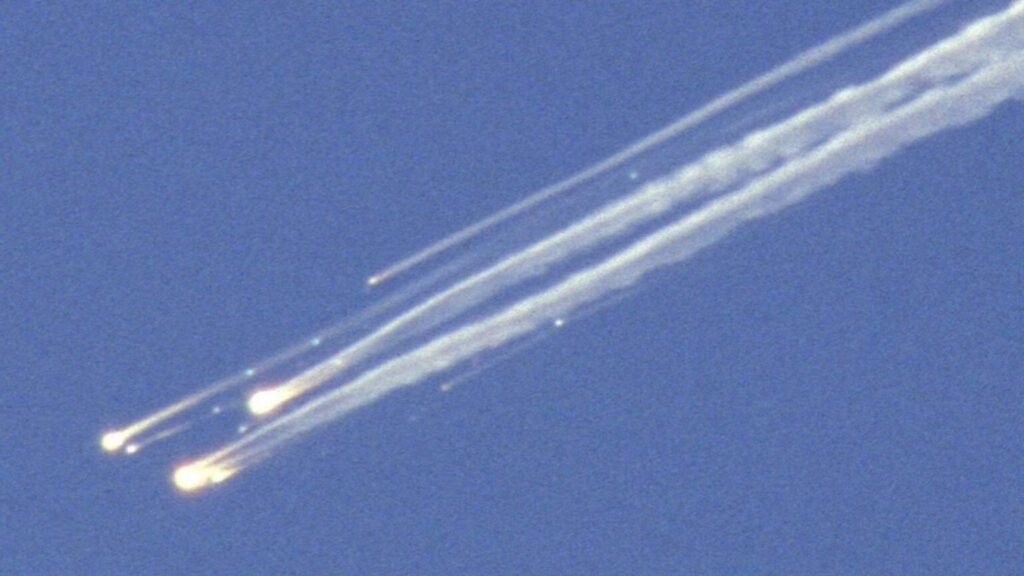
- On re-entry, 1 February 2003, superheated plasma enters through the breach in the wing leading edge at approximately Mach 24
- Sensor data shows anomalous heating in the left wing; the crew is unaware
- Columbia disintegrates over Texas at approximately 200,000 feet and Mach 18
- All seven crew members — Rick Husband, William McCool, Michael Anderson, Ilan Ramon, Kalpana Chawla, David Brown, Laurel Clark — die
The Columbia Accident Investigation Board (CAIB) concluded that the physical cause was the foam strike, but that the organisational causes — the culture of NASA that silenced engineering concerns and normalised foam strikes as an acceptable risk — were equally responsible for the loss.
Systems Engineering Perspective
From a systems engineering perspective, Columbia reveals how a safety management system can fail structurally — not through any single dramatic error, but through the slow accumulation of organisational practices that systematically suppress safety-critical information before it reaches decision-makers.
The foam strike was a known, recurring phenomenon. Its damage potential had never been fully quantified, because the question had been treated as already settled — foam strikes were an accepted operational risk. Columbia demonstrated that treating an unquantified, recurring hazard as acceptable is not a risk management decision. It is a risk avoidance decision.
The decision not to definitively assess the foam strike damage was not a decision made on evidence. It was a decision made on assumption — the assumption that if nothing had gone wrong before, nothing would go wrong now.
Foam Strikes — Normalised Deviation Over Sixteen Missions
Foam liberation from the external tank had occurred on multiple previous shuttle missions. In some cases, damage to the Thermal Protection System tiles had been observed post-landing. In each case, the orbiter had survived re-entry. The system had gradually incorporated foam strikes as an expected, manageable occurrence rather than a recurring safety hazard requiring active mitigation.
This is the precise definition of normalisation of deviation: a departure from designed standards — foam should not strike the orbiter — that is incorporated into operational expectations because previous deviations have not produced immediate consequences. Each successful flight that survived foam strike damage reinforced the incorrect belief that foam strikes were acceptable.
Normalisation of deviation is the process by which ‘this happens and nothing bad has occurred yet’ becomes operationally equivalent to ‘this is safe.’ Columbia proved they are not equivalent.
The Request for Better Imagery — Denied
During the sixteen days of STS-107’s mission, NASA engineers in the Debris Assessment Team wanted better photographic imagery of the left wing leading edge — from ground-based telescopes or from Department of Defense surveillance assets — to assess the extent of any damage. Requests were made through the Mission Evaluation Room. They were not escalated. The imagery was not obtained.
The reason given was that even if damage was found, nothing could be done. This reasoning — ‘we can’t fix it so we don’t need to know about it’ — is among the most dangerous in safety management. Knowing the damage would have allowed preparation of rescue options, modification of re-entry attitude to reduce loads on the damaged area, or a decision to postpone re-entry. None of these options were assessed because the decision had already been made that assessment was unnecessary.
‘We can’t fix it so we don’t need to know’ is not a safety management decision. It is an abdication of safety management. Knowing the risk — even an unmitigatable one — enables informed decision-making. Not knowing guarantees uninformed decision-making.
Management Hierarchy Suppressing Technical Concern
The Columbia Accident Investigation Board specifically identified the management hierarchy of the Space Shuttle Program as a barrier to safety-critical information reaching decision-makers. Engineers who raised concerns about the foam strike damage were told their concerns had been addressed when they had not been. The formal channels for engineering dissent were structurally inadequate for the cultural environment in which they operated.
This mirrors the Challenger O-ring analysis of 1986 with unsettling precision. In both cases, engineers with the relevant technical knowledge raised concerns. In both cases, management hierarchy filtered, diluted, and ultimately suppressed those concerns before they reached the decision-maker who could have acted on them.
Human Factors Perspective
The human factors analysis of Columbia is inseparable from its organisational analysis. Individual humans made decisions that contributed to the loss — but each individual operated within an institutional context that shaped, constrained, and ultimately determined those decisions.
The Culture of Schedule and Production Pressure
The Space Shuttle Program in 2003 was under significant pressure to maintain its flight schedule in support of International Space Station construction commitments. The CAIB found that schedule pressure was a systemic influence on the safety management culture — not through explicit instruction to cut corners, but through the institutional message that delays were costly and problems needed to be resolved, not escalated.
When an organisation’s culture makes raising safety concerns feel like causing problems, engineers face a choice between professional obligation and institutional belonging. The Columbia engineers who raised concerns were doing the right thing in a culture that had made the right thing feel wrong.
When raising a safety concern feels like causing a problem in an organisation’s culture, the safety management system has failed before any specific decision is made.
The Ghost of Challenger — Unlearned Lessons
Columbia occurred exactly seventeen years after the Challenger disaster — another shuttle lost to a known, normalised technical risk that management had accepted as controllable. The CAIB found that many of the organisational failure modes identified by the Rogers Commission after Challenger had been partially addressed but not eliminated. The same cultural patterns — suppression of dissenting technical opinion, schedule pressure over safety margin, normalisation of known hazards — had reasserted themselves.
This is the most important systemic finding about Columbia: an organisation that has experienced a major safety failure can revert to the patterns that caused it unless the structural corrections are maintained actively and permanently.
Safety culture is not a fixed state. It is a continuous effort. An organisation that stops maintaining its safety culture will drift back toward the patterns that produced its worst failures.
The Crew
The seven crew members of STS-107 were unaware of the extent of the tile damage until re-entry began. The anomalous heating data from the left wing reached Mission Control 8 minutes before breakup — the crew were informed only seconds before contact was lost. They could not have known what was happening, or why, until it was too late. Their professionalism and composure in the final moments of the mission are documented in the recovered voice recorder data.
System Interaction Breakdown
1. Recurring Hazard Treated as Acceptable
Foam strikes were normalised over sixteen missions. The physical damage potential was never fully quantified because the question had been treated as settled. The assumed acceptability was not based on engineering analysis — it was based on survival of previous events.
Surviving a hazard is not the same as proving the hazard is safe. It is evidence that you were lucky. Columbia was the mission on which the luck ran out.
2. Safety Information Filtered Before Reaching Decision-Makers
Engineering concerns were suppressed, filtered, and re-framed by the management hierarchy before reaching the program manager. The decision to proceed was made without the full picture of the technical concerns that existed.
3. Alternative Options Not Assessed
Rescue options, re-entry profile modifications, and extended mission options were not formally assessed because the decision had been made that assessment was unnecessary. The operational flexibility that might have existed was never evaluated.
Not knowing your options is a choice. Choosing not to know your options in the face of an unresolved risk is not risk management — it is risk denial.
Significance in Aviation Risk
1. CAIB and NASA Reform
The Columbia Accident Investigation Board produced 29 recommendations spanning technical, programmatic, and organisational changes. NASA undertook significant restructuring of its safety management culture, inspection programmes, and communication systems as a direct result.
2. Normalisation of Deviation — Named and Formalised
Columbia gave the concept of normalisation of deviation its clearest and most tragic case study. The term — originally coined by sociologist Diane Vaughan in her analysis of the Challenger decision — was validated and amplified by the Columbia investigation as a primary causal mechanism in major accidents.
3. Organisational Safety Culture as a Safety System
Columbia, following Challenger, established that the organisational culture of a complex safety-critical institution is itself a component of the safety system — one that requires active maintenance, independent assessment, and structural protection against the commercial and schedule pressures that corrode it.
4. Information Suppression Architecture
The investigation drove redesign of NASA’s information pathways to ensure that engineering dissent could not be filtered out before reaching programme managers. The formal engineering dissent mechanism was restructured to provide direct access.
Related Aviation Risk Lab Content
Pillar Pages
Human Factors: Human Factors
Systems Engineering: Systems Engineering
Safety Engineering: Safety Engineering
Risk Assessment: Risk Assessment
Related Case Studies
Case Study: Tenerife — When a System Has No More Margins Left: Tenerife 1977
Case Study: Germanwings 9525 — The System That Couldn’t See: Germanwings 9525
Case Study: Turkish Airlines 981 — A Door That Was Never Safe: Turkish 981
Closing Perspective
The Columbia accident is the case study that proves that an organisation’s safety culture is not a soft metric — it is a hard safety system component with the same weight as physical design, inspection standards, and operational procedures. When the culture fails, people die. When the culture suppresses the engineers who know something is wrong, people die.
Seven people on STS-107 trusted that the system that put them in orbit had assessed the risks adequately. The system had not. It had assessed the history of surviving similar risks and concluded the risk was acceptable. History is not engineering. Survival is not safety. The absence of a previous catastrophe is not evidence of an acceptable risk. It is evidence of previous luck.
The CAIB’s final report remains one of the most important documents in safety management. Its analysis of organisational factors in catastrophic accidents applies with equal force to aviation, nuclear, oil and gas, and every other high-consequence industry. The lesson is universal and unambiguous: when engineers raise concerns, those concerns must reach the people who can act on them, through systems that cannot be overridden by institutional culture.
Columbia is the proof that organisational culture kills. The foam struck the wing in January. The culture killed the crew in February.