Qantas Flight 32 is often described as a “successful emergency landing.”
But that description undersells what actually happened.
This was not just a skilled crew handling an emergency. It was a complex interaction between:
- multiple system failures
- layered redundancy
- human decision-making under uncertainty
- and structured operational response
The key outcome was not the absence of failure—but the system’s ability to contain it.
What Happened
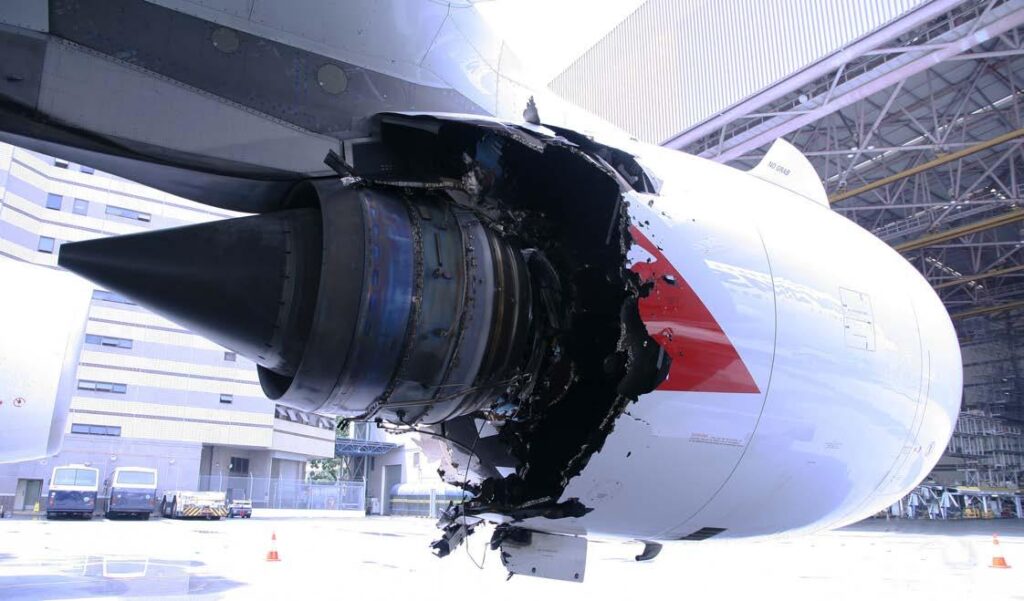
On 4 November 2010, Qantas Flight 32, an Airbus A380 operating from Singapore to Sydney, experienced a catastrophic uncontained engine failure shortly after take-off.
One of the aircraft’s engines suffered a major internal failure, leading to:
- debris damage to the wing
- loss of multiple systems
- fuel leaks and system warnings
- partial system degradation across the aircraft
Despite this, the aircraft remained controllable.
The crew returned safely to Singapore and landed without further injury.
System-Level Complexity of the Failure
This event was not a single failure—it was a cascade of interacting system issues.
The engine failure alone was severe, but the consequences expanded because:
- hydraulic systems were affected
- fuel systems were damaged
- electrical systems produced conflicting alerts
- multiple cockpit warnings activated simultaneously
The crew was not dealing with one problem.
They were dealing with a network of interdependent failures.
Why This Did Not Become a Catastrophe
The critical factor in this case is not what failed—but what did not fail enough to allow total loss of control.
Several system properties prevented escalation:
1. Redundancy in aircraft design
The A380 is designed with multiple independent systems. When one fails, others can compensate.
2. Functional degradation rather than total collapse
Systems did not fail all at once. They degraded in layers, allowing partial control to remain.
3. Crew decision-making under structured uncertainty
The crew was presented with inconsistent and incomplete information but maintained procedural discipline.
4. Effective prioritisation of control over diagnosis
Instead of attempting to fully diagnose every fault, the crew focused on stabilising flight conditions.
Human Factors in the Event
This case is often misrepresented as purely a technical success.
In reality, human factors played a critical role:
- high cognitive workload due to multiple warnings
- conflicting system messages
- time pressure and uncertainty
- need to filter irrelevant or misleading alerts
The crew’s ability to prioritise control over information overload was essential.
However, this capability was only effective because the system still provided enough functional integrity to act upon.
System Design and Resilience
Qantas Flight 32 is a strong example of system resilience in aviation.
Resilience here means:
the ability of a system to continue functioning under degraded conditions
Key design features that supported this included:
- independent system architectures
- physical separation of critical components
- multiple fallback pathways for control
- warning prioritisation logic (despite overload challenges)
Importantly, resilience is not the absence of failure—it is the ability to absorb it.
What Could Have Gone Wrong
This event had multiple potential escalation points:
- loss of additional engine functionality
- cascading hydraulic system failure
- misinterpretation of conflicting alerts
- delayed decision-making due to information overload
Any one of these could have shifted the outcome significantly.
This highlights a key principle in systems thinking:
safety is often a matter of remaining within survivable boundaries during failure, not preventing failure entirely.
Key Lessons from Qantas Flight 32
This case demonstrates several core principles of modern aviation safety:
1. Failures are rarely isolated
They propagate through system interactions.
2. Redundancy matters only if it is truly independent
Interconnected redundancy can fail in correlated ways.
3. Information overload is a real operational risk
Too much conflicting data can be as dangerous as too little.
4. Human performance depends on system design
Good decisions require usable information, not just skill.
5. Safety is often about containment, not prevention
The goal is to prevent escalation beyond recoverable limits.
Conclusion
Qantas Flight 32 is not just a story of successful airmanship.
It is a demonstration of how modern aviation safety is built on layered systems, redundancy, and the ability to absorb failure without catastrophic collapse.
The aircraft did not avoid failure.
It survived it.
And that distinction is central to understanding how complex aviation systems actually achieve safety in practice.