Risk assessment is one of the core processes in aviation safety management.
At a surface level, it looks structured and procedural: identify hazards, assess likelihood, assign severity, and implement controls.
But in reality, risk assessment is not purely mechanical.
It is a structured way of dealing with uncertainty in complex systems where outcomes cannot always be predicted with precision.
What Aviation Risk Assessment Is Trying to Do
At its core, aviation risk assessment tries to answer three questions:
- What could go wrong?
- How likely is it to happen?
- What would happen if it does?
These questions seem simple. The difficulty lies in the environment they are applied to.
Aviation systems are:
- highly dynamic
- tightly coupled
- influenced by human behaviour
- affected by external conditions
This means risk is not static—it changes depending on context.
Step 1: Identifying Hazards
The first step is identifying hazards—anything that could potentially lead to harm.
Hazards can come from:
- technical systems (equipment, automation, interfaces)
- human performance (fatigue, workload, decision-making)
- operational conditions (weather, traffic, scheduling pressure)
- organisational factors (training, procedures, culture)
Importantly, hazards are not always obvious failures.
Often, they are normal aspects of operations that can become dangerous under certain conditions.
Step 2: Understanding the Context
A hazard on its own does not define risk.
Context determines how serious it is.
For example:
- the same technical issue may be minor in cruise but critical during take-off
- the same workload may be manageable in normal conditions but overwhelming during disruption
Risk assessment must therefore consider:
when, where, and how a hazard might occur
Step 3: Estimating Likelihood
Once hazards are identified, the next step is estimating how likely they are to occur.
This is where uncertainty becomes important.
Likelihood is often based on:
- historical data
- operational experience
- expert judgement
- system reliability information
However, aviation systems are not always statistically stable. Rare events may have limited data, making estimation partly subjective.
This is why likelihood is never an exact science—it is an informed approximation.
Step 4: Assessing Severity
Severity refers to the potential consequence if the hazard occurs.
In aviation, consequences are usually categorised as:
- negligible
- minor
- major
- catastrophic
Severity is often more stable than likelihood, but it still depends on scenario context.
For example:
- a minor technical failure may become severe under high workload
- a small delay in response may have different outcomes depending on phase of flight
Step 5: Combining Likelihood and Severity
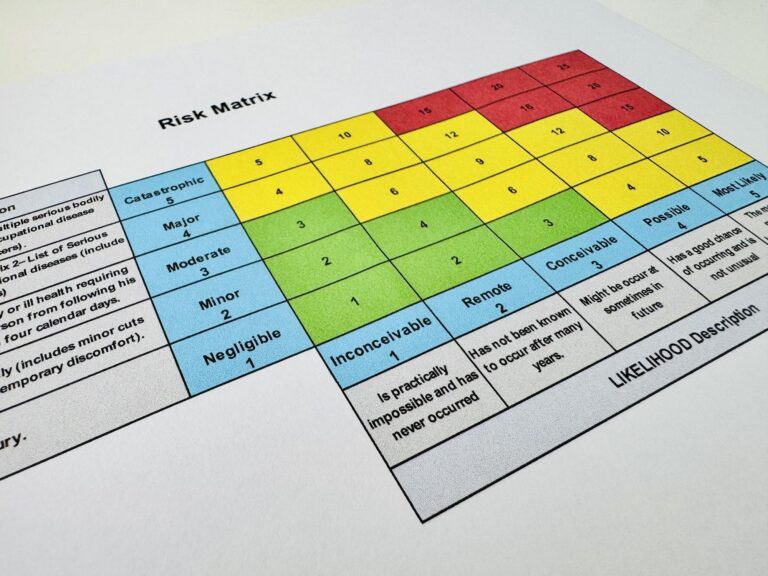
Risk is typically represented as a combination of likelihood and severity.
This is often done using a risk matrix.
The goal is not precision—it is prioritisation.
The matrix helps determine:
- which risks require immediate action
- which can be monitored
- which are acceptable under current controls
However, it is important to recognise that risk matrices simplify reality. They reduce complex interactions into categories.
Step 6: Applying Controls
Once risk is assessed, controls are implemented to reduce it.
Controls can include:
- procedural changes
- training updates
- system redesign
- operational limits
- redundancy improvements
Effective controls typically aim to:
- reduce likelihood
- reduce severity
- or increase system resilience
In high-reliability environments like aviation, multiple layers of control are often used rather than relying on a single fix.
Step 7: Continuous Monitoring
Risk assessment is not a one-time activity.
Conditions change over time:
- systems are updated
- procedures evolve
- operational pressure shifts
- new failure modes emerge
This means risk must be continuously reviewed and adjusted.
Aviation safety systems rely heavily on feedback loops to ensure risk remains understood in real time.
Limitations of Risk Assessment Models
While structured, risk assessment has limitations:
- it relies on assumptions about future behaviour
- it simplifies complex interactions
- it depends on quality of data and judgement
- it may not fully capture rare or cascading failures
Because of this, risk assessment is best viewed as a decision-support tool, not a prediction system.
Why This Matters in Aviation Safety
Despite its limitations, risk assessment is essential because it provides:
- structure in uncertainty
- prioritisation of safety efforts
- shared understanding across teams
- a basis for proactive safety management
Without it, safety decisions become reactive rather than systematic.
Conclusion
Aviation risk assessment is not about eliminating uncertainty.
It is about managing it in a structured way.
By identifying hazards, evaluating likelihood and severity, and applying controls, aviation systems reduce the probability of failure—but never eliminate it entirely.
This is why continuous monitoring and systems thinking remain essential parts of modern aviation safety.